11. Hardware Co-processor
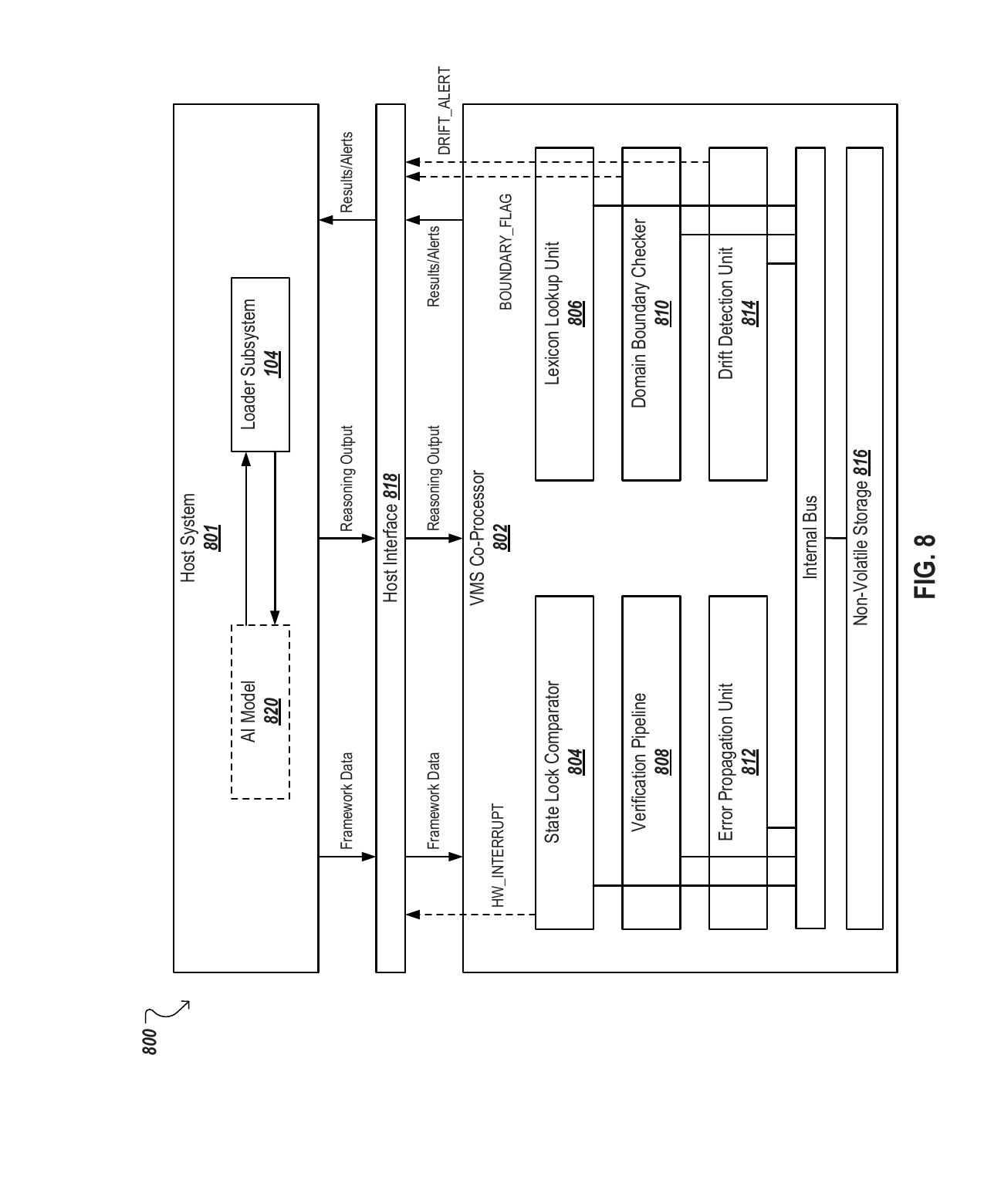
[0254]FIG. 8 is a block diagram illustrating a system 800 that includes a dedicated physical co-processor 802 and a host system 801. The example system 800 provides an alternative execution layout that features the dedicated physical hardware co-processor 802 interacting with a host computing architecture designated as a host system 801 through a specialized communication layer designated as a host interface 818. This hardware layout establishes a hardware-software hybrid governance configuration where high-throughput framework verification, constraint enforcement, and drift monitoring occur within dedicated physical circuitry to avoid consuming processing cycles of the primary host processor. The host system 801 executes an AI model 820, such as an LLM or a deep neural network, alongside a software-based loader subsystem 104. The host interface 818 bridges the host system 801 with the physical hardware co-processor 802 (e.g., a CPU, GPU, TPU, etc.), providing hardware abstraction and data routing across high-speed data pathways, including peripheral component interconnect express channels, buses, or other types of physical interconnects.
[0255]The host interface 818 routes multiple discrete data streams between the software layers of the host system 801 and the physical hardware co-processor 802. When an incoming framework package is parsed by the loader subsystem 104, the raw or compressed framework data is transmitted across the host interface 818 to initialize the hardware structures of the physical hardware co-processor 802. During active operation, the host system 801 passes nascent text segments or mathematical expressions from the AI model 820 across the host interface 818 as a reasoning output data stream. In return, the physical hardware co-processor 802 processes these tokens in real time and streams validation metrics, synchronization status flags, or corrective annotations back to the host system 801 via a results and alerts feedback channel.
[0256]The physical hardware co-processor 802 incorporates multiple concurrent hardware logic blocks interconnected by an internal bus for low-latency communication. The scale lock comparator 804 is implemented as a fixed-function hardware comparison unit that holds a registered scale lock value, such as S₀ = ℏ, within a dedicated local physical hardware register. During live operational reasoning, the scale lock comparator 804 intercepts mathematical parameters, assignments, and numeric evaluations routed from the AI model 820 to perform single-cycle comparator evaluations. This comparison occurs directly within the arithmetic logic of the scale lock comparator 804 without invoking the floating-point unit or instruction cycles of the host system 801, enabling real-time constant validation. If a variable modification, unauthorized constant tuning, or floating parameter assignment is identified by the hardware logic, the scale lock comparator 804 suppresses the unauthorized token generation and generates a hardware interrupt to notify the host runtime environment.
[0257]The lexicon lookup unit 806 can be implemented as a hardware-accelerated associative memory configuration, such as a content-addressable memory architecture. The content-addressable memory is initialized from the compressed framework package 103 at load time and operates as a read-only hardware registry during active model execution. This layout stores the registered lexicon of domain primitives, legacy terminology aliases, and authoritative canonical definitions to enable single-cycle or constant-time database lookup operations during token validation.
[0258]The verification pipeline 808 is constructed as a multi-stage hardware processing pipeline that executes the staged verification protocol as a series of sequential electronic steps. Each pipeline stage performs a discrete validation gate, including cryptographic file integrity verification, quote-back hash comparisons, lexical graph enumerations, and holdout observable range evaluations, passing intermediate metrics to the next stage via synchronized hardware registers. The verification pipeline 808 generates a single pass or fail output status flag and an encrypted verification token without relying on software-level host execution loops.
[0259]The domain boundary checker 810 is implemented as a dedicated hardware comparison array that holds the complete domain boundary specification within local physical registers. The local registers store explicit range matrices covering allowed physical parameter scales, material types, operating environments, and valid physical regimes. The domain boundary checker 810 executes parallel range checks on incoming prompt parameters during a pre-check cycle and outgoing predictions during a post-check cycle simultaneously within a single clock cycle.
[0260]The error propagation unit 812 is constructed as a specialized hardware arithmetic logic block that executes operation-level uncertainty tracking in real time. The error propagation unit 812 features hardware-coded arithmetic logic gates tailored to distinct propagation behaviors, applying specific electronic tracking rules for multiplication, division, addition, subtraction, and exponentiation steps. This circuitry computes the compiled relative variance at each calculation step independently of the floating-point architecture of the host system 801, comparing uncertainty growth against a hardcoded baseline closure tolerance threshold.
[0261]The drift detection unit 814 is implemented as an analytical token-filtering hardware block that works in conjunction with the lexicon lookup unit 806 to suppress terminology drift over extended reasoning sessions. The drift detection unit 814 incorporates hardware comparator arrays and local circular tracking buffers to evaluate the context of active word forms against the vector representations stored in the content-addressable memory. The local circular tracking buffers maintain a running trend analysis across a sliding history of consecutive outputs to identify slow, creeping deviations from the registered definitions. When a systematic vocabulary divergence breaches the configured tolerance threshold, the drift detection unit 814 outputs a real-time drift alert across the interconnect to initiate automated recovery loops or prompt human intervention.
[0262]To ensure absolute operational isolation, the physical hardware co-processor 802 features an on-card non-volatile storage 816, such as a secure flash memory block, connected to the internal bus. The non-volatile storage 816 retains a local copy of the compressed framework package, the historical verification logs, and an unalterable audit log chain. This persistent architecture ensures that framework governance, constraint parameters, and forensic records are maintained with absolute structural integrity even across restarts of the host system 801 or volatile memory clear operations.
[0263]The execution layout illustrated in FIG. 8 defines a hardware approach to implementing the core tracking, monitoring, and governance framework described with respect to the system of FIGs. 1A and 1B. Within this alternative structural arrangement, each dedicated functional module embedded within the physical hardware co-processor 802 can be configured to implement the exact functional rules, analytical evaluations, and protective operations associated with the corresponding subsystems of FIGs. 1A and 1B. This physical configuration enables real-time verification and drift monitoring to proceed over the host interface 818 at the native clock speed of the physical hardware co-processor 802, providing secure data processing that operates independently of the host system 801.
[0264]The scale lock comparator 804 can be configured to implement the same constant validation and immutability protection functionality as the scale enforcement subsystem 112 of FIG. 1B. This hardware implementation can be achieved by utilizing a fixed-function hardware comparison unit that holds a registered scale lock value within a dedicated local physical register to execute single-cycle comparator evaluations on incoming parameters, generating a hardware interrupt if an unauthorized variable modification is detected.
[0265]The lexicon lookup unit 806 can be configured to implement the terminology translation and mapping functionality of the lexicon mapping subsystem 110 of FIG. 1B. This hardware implementation can be achieved by utilizing a hardware-accelerated associative memory configuration, such as a content-addressable memory architecture, that is initialized from the compressed framework package 103 at load time to enable constant-time lookups and bidirectional substitutions of vocabulary terms at hardware speeds.
[0266]The verification pipeline 808 can be configured to implement the multi-pass initialization validation gating functionality of the verification subsystem 106 of FIG. 1B. This hardware implementation can be achieved by deploying a sequential electronic processing pipeline where distinct hardware stages systematically evaluate file integrity checks, quote-back confirmations, lexical enumerations, and holdout stress tests, passing intermediate evaluation metrics to subsequent stages via synchronized internal registers to emit a verification token.
[0267]The domain boundary checker 810 can be configured to implement the parameter range filtering and regime enforcement functionality of the domain boundary subsystem 118 of FIG. 1B. This hardware implementation is achieved by constructing a dedicated hardware comparison array that holds multi-dimensional matrix limits within local physical registers to execute parallel range checks on input parameters and output values simultaneously within a single clock cycle.
[0268]The error propagation unit 812 can be configured to implement the mathematical uncertainty tracking and variance bounding functionality of the error propagation subsystem 116 of FIG. 1B. This hardware implementation can be achieved by embedding a specialized arithmetic logic block containing hardware-coded logic gates tailored to distinct arithmetic operations, which computes the compiled relative variance at each derivation step independently of the primary processing assets of the host system 801.
[0269]The drift detection unit 814 can be configured to implement the semantic monitoring and context validation functionality of the drift detection subsystem 114 of FIG. 1B. This hardware implementation is achieved by integrating hardware comparator arrays with local circular tracking buffers to analyze a sliding trend history of consecutive outputs, querying the content-addressable memory of the lexicon lookup unit 806 to generate a real-time drift alert when terminology usage patterns diverge from registered definitions.
[0270]The non-volatile storage 816 can be configured to implement the local asset retention and transaction recording functionality associated with the message bus and audit log 120 of FIG. 1B. This hardware implementation is achieved by deploying a physical non-volatile storage matrix directly onto the card of the physical hardware co-processor 802 to preserve a local copy of the compressed framework package 103, historical verification tokens, and an unalterable audit log chain across operations.