10. Ordering Controller and State Machine
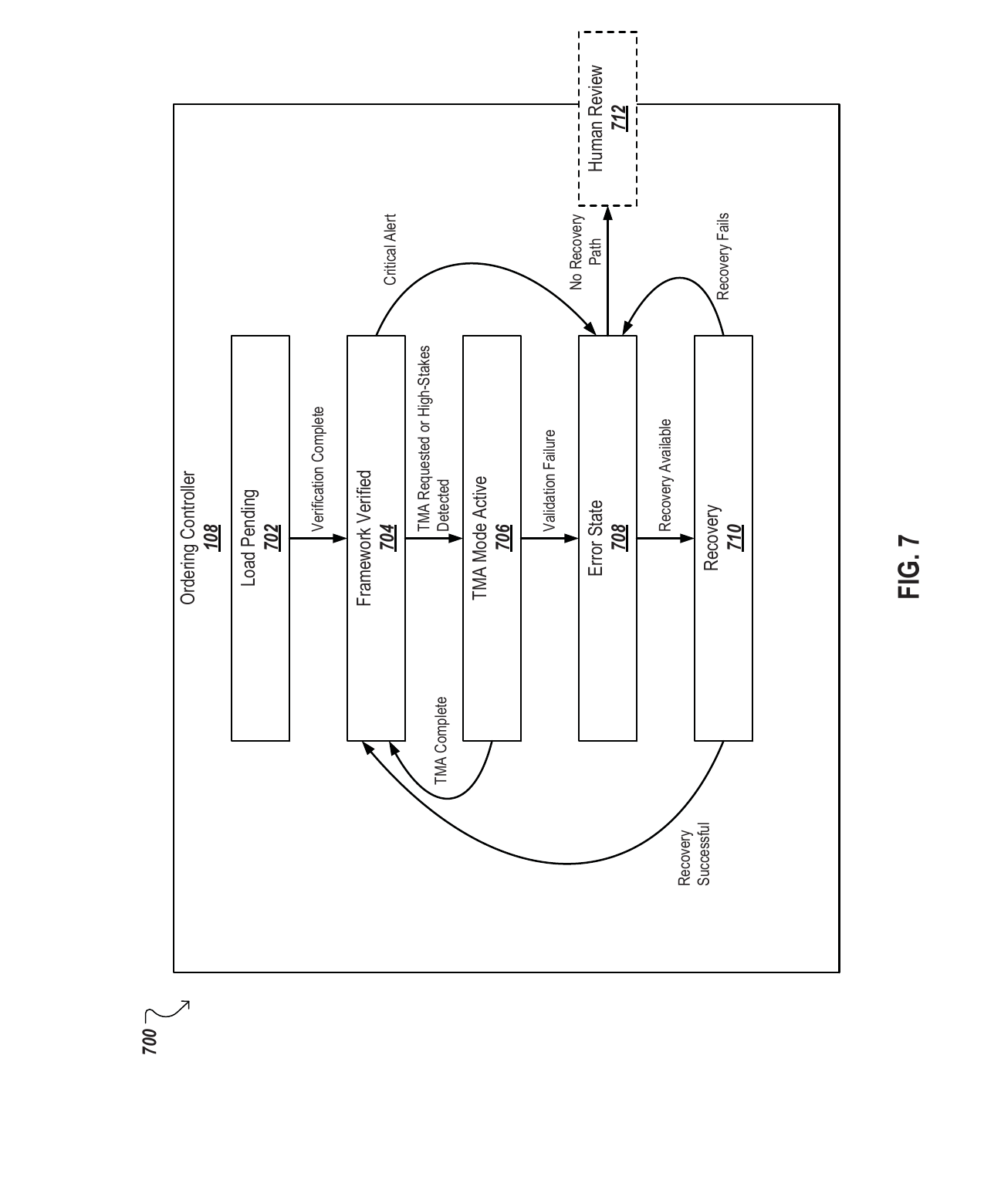
[0239]FIG. 7 is a state machine diagram 700 illustrating example operational states and recovery transitions managed by an ordering controller 108 to govern state and pipeline configurations. The state machine 700 can be configured to establish a deterministic hardware-software hybrid governance layer that guides the initialization pipeline 101 and the runtime execution pipeline 102 through distinct state phases based on incoming programmatic control alerts and validation signals.
[0240]The load pending state 702 defines the initial protective lockout and startup configuration of the state machine diagram 700 managed by the ordering controller 108. When a new structured knowledge framework package 103 is introduced, the initialization pipeline 101 shifts internal processing states to the load pending state 702 to completely isolate the core execution layers. While operating within the load pending state 702, the ordering controller 108 blocks the execution of incoming data transactions, active user queries, or inference tasks from reaching the external AI model. During operation within the load pending state 702, only the loader subsystem 104 and the verification subsystem 106 are active, and reasoning operations using the incoming technical framework are entirely precluded. The ordering controller 108 is configured to maintain the load pending state 702 until specific programmatic signals indicate that the framework package ingestion is verified and structurally established within the active context memory window.
[0241]A transition from the load pending state 702 to a framework verified state 704 is initiated by a verification complete trigger, which occurs when the verification subsystem 106 successfully completes all validation substages inside the staged verification protocol. The verification subsystem 106 executes a sequence of rule-based validation gates, including a load-and-integrity check, a quote-back confirmation, a lexical enumeration check, and a stress test against holdout observables. When each validation gate returns a successful pass result, the completion stage 210 generates a programmatic control signal designated as the framework verified signal and transmits the framework verified signal downstream to the ordering controller 108. This framework verified signal prompts the ordering controller 108 to execute an internal state change, transitioning the runtime execution pipeline 102 out of the load pending state 702 and into the framework verified state 704.
[0242]The framework verified state 704 represents the baseline operational configuration where active reasoning tasks are authorized under continuous background governance modules. Upon transitioning into the framework verified state 704, the ordering controller 108 generates and broadcasts an all modules active signal to subsequent components within the runtime execution pipeline 102. This all modules active signal switches the lexicon mapping subsystem 110, the drift detection subsystem 114, the scale enforcement subsystem 112, the error propagation subsystem 116, and the domain boundary subsystem 118 from an inactive configuration to a live monitoring configuration. Active model queries and token-generation steps are permitted to execute while the runtime execution pipeline 102 resides within the framework verified state 704, provided that no structural or mathematical constraint violations are encountered by the background governance modules.
[0243]A transition from the framework verified state 704 to the transparent math-audit mode active state 706 is initiated by a transparent math-audit requested or high-stakes detected trigger. This transition trigger occurs when an external operator explicitly requests enhanced auditing via an application programming interface flag or a dedicated configuration command. Alternatively, the transition trigger is automatically generated when the component of the system detects that an active calculation involves a high-stakes domain parameter, including safety-critical operational temperatures, structural engineering loads, or resource-constrained physical variables. Upon receiving either a manual or an automated audit request, the runtime execution pipeline 102 sets an internal audit active flag, which causes the ordering controller 108 to shift the pipeline configuration out of the framework verified state 704 and into the transparent math-audit mode active state 706.
[0244]The transparent math-audit mode active state 706 defines a specialized reasoning configuration wherein the AI architecture is instructed to expose its entire intermediate derivation sequence for independent expert review. While the runtime execution pipeline 102 remains in the transparent math-audit mode active state 706, the background governance modules switch to an enhanced monitoring frequency where every sequential derivation step is analyzed rather than relying on a rolling statistical window of outputs. The AI model applies a structured template that demands explicit tracking of equation identifiers, dependency chains, physical justifications, substitutions with source tags, dimensional analysis, and tolerance propagation. This comprehensive logging creates an immutable, machine-readable audit record within non-transitory storage to enable complete forensic traceability without requiring re-execution of the model inference.
[0245]A transition from the transparent math-audit mode active state 706 back to the framework verified state 704 is initiated by a transparent math-audit complete trigger. This transition trigger occurs when the specific multi-step derivation sequence finishes successfully and the AI architecture outputs a finalized transparent math-audit summary report. When this summary report is compiled, the component of the system clears the internal audit active flag, saves the completed derivation trail as an unalterable audit log entry, and causes the ordering controller 108 to transition the pipeline configuration out of the transparent math-audit mode active state 706 to resume standard monitoring in the framework verified state 704.
[0246]A transition from the framework verified state 704 to the error state 708, or from the transparent math-audit mode active state 706 to the error state 708, is initiated by a validation failure or a critical alert trigger. During active reasoning within the framework verified state 704, or during detailed auditing within the transparent math-audit mode active state 706, the background modules concurrently analyze the generated token streams. If the drift detection subsystem 114 registers terminology deviations exceeding similarity thresholds, or if the scale enforcement subsystem 112 intercepts a numeric mutation of a locked constant, a critical violation event is published to the message bus 120. Similarly, if the error propagation subsystem 116 computes a relative variance that breaches the registered baseline closure tolerance threshold, a critical alert message is routed directly to the central state machine over the decoupled event layer. Reception of this master exception signal causes the ordering controller 108 to instantly suppress execution triggers and shift the operational environment into the error state 708.
[0247]The error state 708 defines a protective lockout configuration that suspends active token-generation loops to safeguard framework consistency across distinct execution regimes. While the execution environment resides within the error state 708, the ordering controller 108 isolates the active context memory tracking structures and prevents any unverified calculations or inference data from being released to downstream client nodes or user interfaces. The pipeline remains locked in the error state 708 until a programmatic determination evaluates whether an automated recovery pathway is available, or whether the exception category involves a manual diagnostic hold.
[0248]A transition from the error state 708 to the recovery state 710 is initiated by a recovery available trigger. This transition trigger occurs when the central state machine inside the ordering controller 108 evaluates the serialized exception data packet and identifies that the active error code matches a pre-configured recovery profile. For instance, if the exception stems from a transient file ingestion failure or a corrupt memory cache block, the component of the system determines that an automated reload pathway is accessible. Once a viable mitigation pathway is confirmed, the recovery available signal causes the ordering controller 108 to advance the pipeline configuration out of the error state 708 and into the recovery state 710.
[0249]The recovery state 710 defines an active remediation configuration where the component of the system executes targeted mitigation protocols based on the specific category of the logged error. While operating within the recovery state 710, the runtime architecture initiates automated correction loops designed to resolve the tracking discrepancy without requiring a full manual reboot. The operations executed within the recovery state 710 vary according to the intercepted exception profile, including low-level structural file re-fetches, volatile memory buffer flushes, or step-by-step mathematical tracing routines.
[0250]A transition from the recovery state 710 to the framework verified state 704 is initiated by a recovery success trigger. This transition trigger occurs when the automated mitigation protocols successfully clear the tracking discrepancy and restore the semantic and mathematical closure of the framework. For example, if a terminology drift is corrected by substituting canonical framework primitive identifiers, or if a context flush resolves an attention alignment error, the verification subsystem 106 runs a validation check to confirm that all residuals have returned within allowed bands. Upon verifying a clean baseline, a recovery success signal prompts the ordering controller 108 to transition out of the recovery state 710 and return to the framework verified state 704.
[0251]A transition from the recovery state 710 to the human review state 712 is initiated by a recovery fails trigger. This transition trigger occurs if the automated mitigation protocols run through their designated execution passing loops but fail to bring the parameter estimates or terminology usage back within the registered framework tolerances. The transition trigger is also generated if the automated retry cycles exceed a pre-configured maximum attempt threshold, indicating that the baseline tracking discrepancy represents a persistent structural exception rather than a transient processing fault. When a non-recoverable condition is confirmed, a recovery fails signal causes the ordering controller 108 to shift the pipeline configuration out of the recovery state 710 and route the control flow to the human review state 712.
[0252]A transition directly from the error state 708 to the human review state 712 is initiated by a no recovery path trigger, which is designated by a recovery path routing path indicating a negative determination regarding automated remediation. This direct transition trigger occurs when the incoming exception code is categorized as a terminal safety violation, such as a non-recoverable cryptographic checksum mismatch or an uncalibrated expansion that cannot be mapped to any pre-defined programmatic correction sequence. In the absence of an available automated workaround, the lack of an automated remediation option generates a direct lockdown command that causes the ordering controller 108 to immediately shift the pipeline configuration out of the error state 708 and into the human review state 712.
[0253]The human review state 712 defines a secure diagnostic hold configuration that enforces absolute hardware-software isolation across the reasoning runtime to prevent uncoordinated subsystem failures. While the pipeline configuration remains within the human review state 712, all automated reasoning operations, external interface channels, and token-generation loops are permanently suspended to prevent the propagation of unverified variables into the finalized outputs. The human review state 712 isolates the active tracking infrastructure, encapsulates the complete historical trail of systemic exceptions, and maintains a strict lockout configuration that is maintained until independent manual review or a complete master hardware reset clears the tracking registries.