9. Delivery Architecture
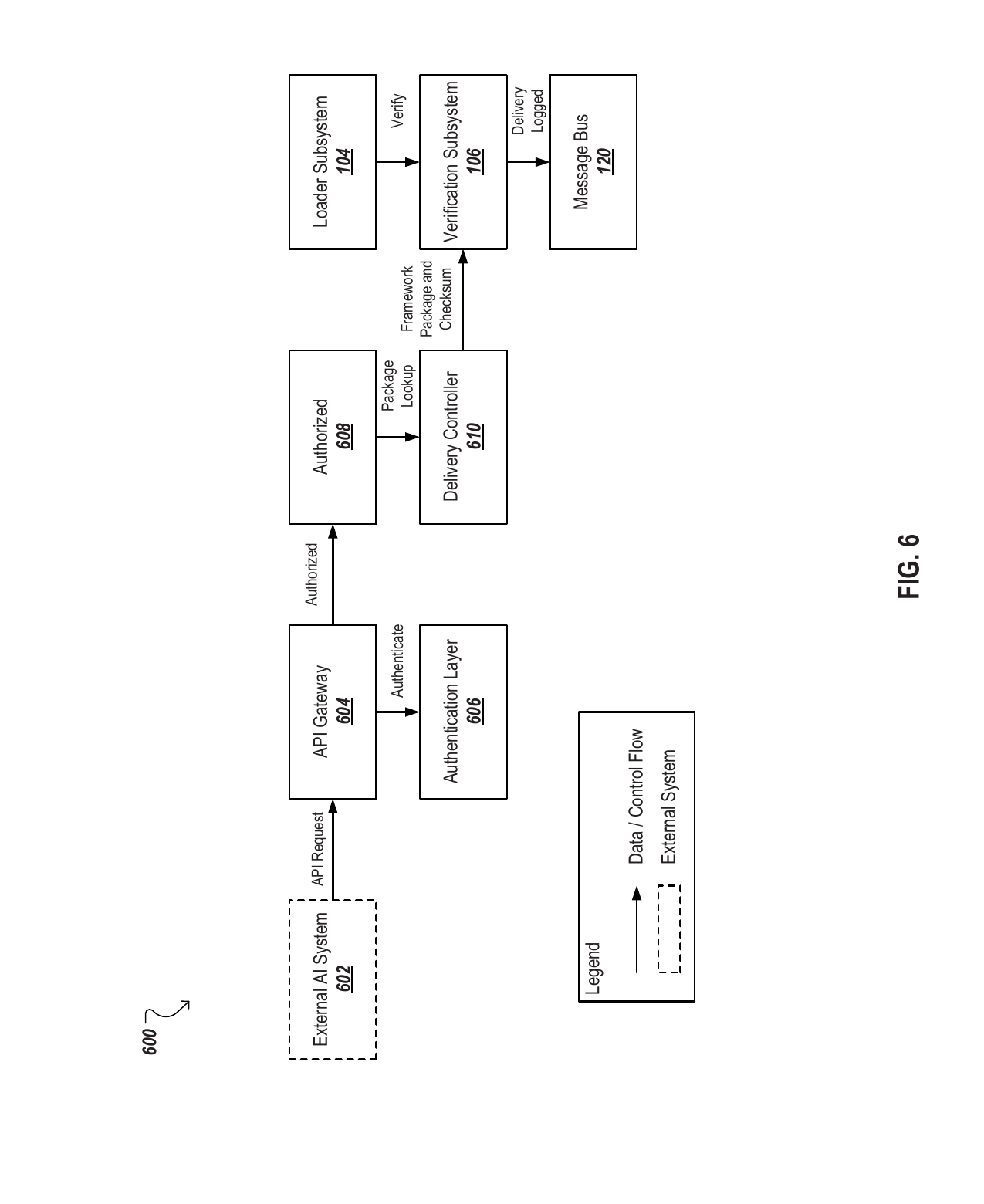
[0233]FIG. 6 is a block diagram illustrating an example framework delivery architecture 600 linking an external AI system 602 to a local tracking infrastructure. The framework delivery architecture 600 is configured to execute the federated delivery of compressed frameworks to AI systems with cryptographic integrity verification. This architecture 600 establishes a secure, authenticated, and auditable ingestion channel that ensures distributed neural networks or client nodes only operate on verified, untampered framework assets. By isolating the external AI system 602 from core database matrices through structured gateway layers, the framework delivery architecture 600 prevents file-level corruption, unauthorized schema modifications, and the loading of out-of-domain technical definitions into the system runtime.
[0234]The framework delivery architecture 600 includes an API gateway 604 that is configured to act as the front-end network interface, traffic management engine, and ingestion boundary for the framework delivery architecture 600. The API gateway 604 receives an incoming API request from the external AI system 602 when a client node or machine learning model attempts to request or pull a compressed knowledge framework. Operating on dedicated network-facing communication hardware processors, the API gateway 604 sanitizes the incoming network packet streams, enforces pre-configured request rate limits to mitigate denial-of-service vulnerabilities, and parses the request headers. Rather than allowing unvalidated queries to directly access downstream storage layers, the API gateway 604 holds the incoming transaction in a pending state and routes an initialization packet to an authentication layer 606 to verify the identity of the requesting node before any file exposure can occur.
[0235]The authentication layer 606 operates as a secure cryptographic validation gate and identity verification module within the framework delivery architecture 600. The authentication layer 606 receives the verification request from the API gateway 604 and extracts unique client identifiers, digital tokens, API access keys, or private-key signatures embedded within the request metadata. The authentication layer 606 cross-references these security credentials against a secure localized database registry of authorized external nodes to validate access permissions. If the client credentials satisfy the security criteria, the authentication layer 606 registers the status as authenticated and transmits an authorized control signal to the package registry 608 to release the session lockout. If the verification fails due to missing, expired, or mismatched credentials, the authentication layer 606 flags the security violation, terminates the active connection at the API gateway 604, and writes an exception log to the tracking infrastructure.
[0236]A package registry 608 serves as the centralized repository, file directory, and asset distribution node within the framework delivery architecture 600. Upon receiving the authorized confirmation signal from the authentication layer 606, the package registry 608 reads the specific framework requirements specified in the incoming API request, such as a request for the VMS framework version metadata block. The package registry 608 coordinates with a delivery controller 610 by triggering an automated package lookup routine to locate the corresponding serialized file asset within system storage. Once the requested asset is identified and verified for schema version compatibility, the package registry 608 fetches the complete self-sufficient framework package and its pre-compiled cryptographic checksum. The package registry 608 then outputs this verified framework package + checksum payload directly to the loader subsystem 104 to initiate localized system loading.
[0237]The delivery controller 610 functions as the backend transaction coordinator, lifecycle monitoring engine, and distribution management block inside the framework delivery architecture 600. The delivery controller 610 is communicatively coupled to the package registry 608 to manage the execution parameters of active package lookup operations, tracking data block stream sizes, transmission speeds, and active network connections. The delivery controller 610 enforces federated distribution policies, ensuring that compressed framework files are transferred without data loss or pipeline saturation across distributed nodes. As the package registry 608 releases the requested payload, the delivery controller 610 updates the internal registry transaction logs to record the successful matching, version alignment, and transmission status of the specific framework asset.
[0238]To complete the end-to-end delivery verification loop, the outputted framework package and checksum payload are received directly by the loader subsystem 104. The loader subsystem 104 decodes the serialized byte stream to map out an in-memory internal semantic graph and transmits a verify control command downstream to the verification subsystem 106. The verification subsystem 106 subjects the delivered package components to the multi-pass security gates defined within the staged verification protocol 200, confirming character-level quote-back fidelity and baseline file integrity. Once the verification subsystem 106 confirms that the framework has been successfully loaded into the active context memory window without error, it transmits a delivery logged status signal to the message bus 120 (which corresponds to the message bus and audit log 120). The message bus 120 records the complete transaction history, including cryptographic checksum matches and timestamps, within a non-transitory computer-readable storage matrix to maintain an immutable, legally defensible audit record of the delivery transaction.