8. Domain Boundary Enforcement
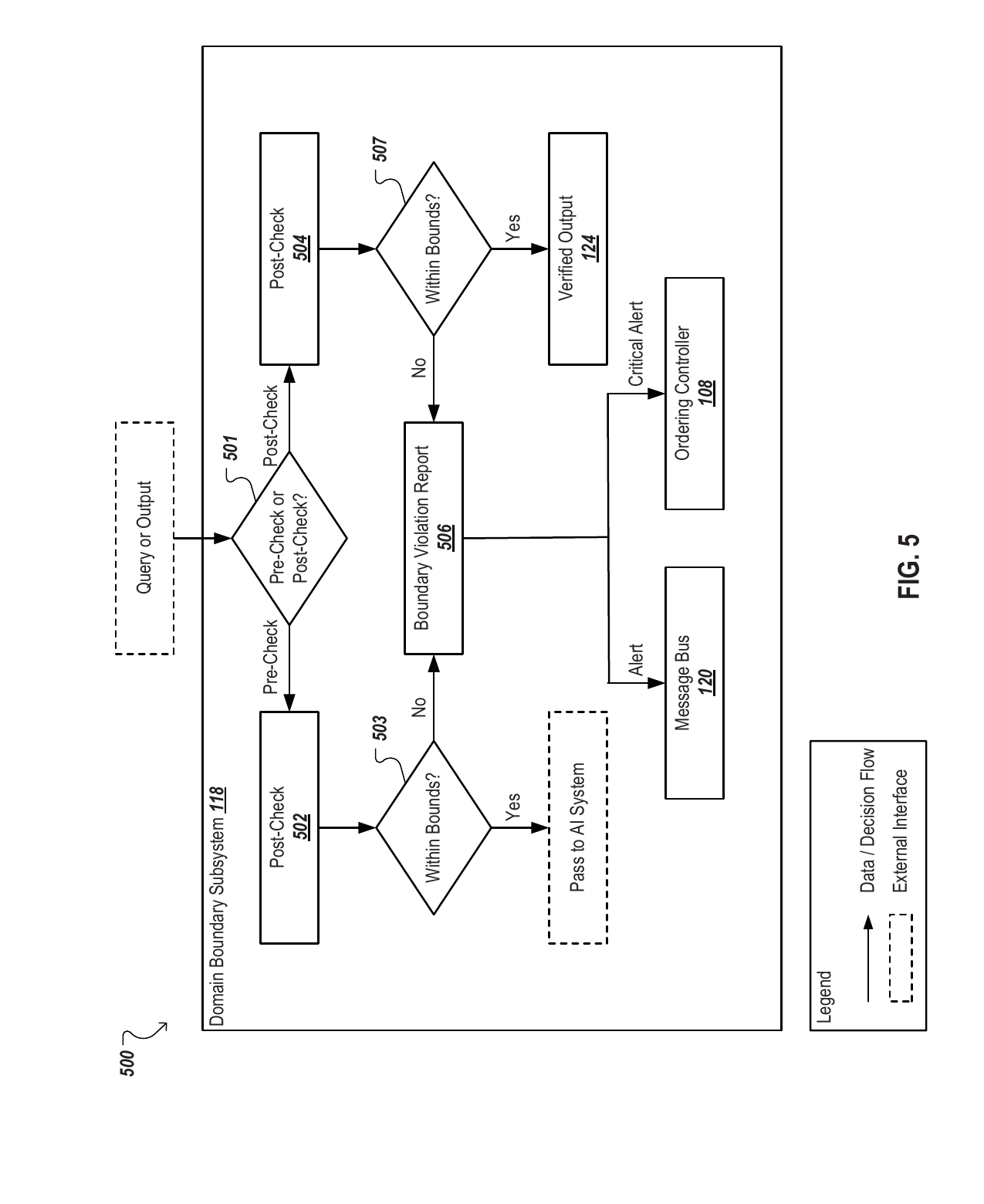
[0227]FIG. 5 is a flowchart illustrating example data and decision flows of a domain boundary subsystem 118 during pre-check and post-check filtering cycles. The process 500 executed by the domain boundary subsystem 118 initiates at the directional routing decision point 501, which determines whether an active transaction undergoes a pre-check filtering cycle or a post-check filtering cycle. The directional routing decision point 501 continuously intercepts digital data packets flowing through the runtime execution pipeline 102, distinguishing between incoming user prompt sequences from the AI query or input 122 and nascent token streams or numerical predictions generated live by the external AI system 126. If the intercepted transaction originates from an external client node or user interface before reaching the inference layers, the directional routing decision point 501 routes the data transaction along a pre-check branch to the pre-check stage 502. Conversely, if the transaction includes live generated outputs or intermediate mathematical derivation steps from the external AI system 126, the directional routing decision point 501 directs the control flow along a post-check branch to the post-check stage 504.
[0228]The pre-check stage 502 receives the incoming transaction stream from the directional routing decision point 501 to enforce rigid operational constraints on the front-end ingestion layer. The pre-check stage 502 intercepts the raw AI query or input 122 to isolate embedded physical parameters, material types, environmental conditions, and physical regimes. The pre-check stage 502 automatically extracts these technical variables and maps them directly against a multidimensional range matrix initialized from the domain configuration rules of the compressed framework package 103. In a VMS framework application, this evaluation includes verifying whether the query specifies particle rest masses between 10-31 to 10-25 kg, electromagnetic field strengths from 10-2 to 45 T, or operating temperatures from 10 mK to 106 K. Once this structural range mapping is complete, the pre-check stage 502 passes the evaluated parameters to the subsequent pre-check decision point 503.
[0229]The pre-check decision point 503 evaluates the validation results generated during the pre-check stage 502 to determine if the requested transaction parameters fall within the safe, validated physical regimes of the framework. If the embedded variables satisfy every hard boundary constraint within the multidimensional range matrix, the pre-check decision point 503 returns a successful YES determination. This positive evaluation releases the optimized query string from the ingress memory buffer and passes the data payload directly to the external AI system 126 to drive the active inference cycle securely. If any parameter falls outside the allowed framework ranges, the pre-check decision point 503 returns a negative NO determination, enacting a hard boundary rejection that permanently blocks the prompt payload from reaching the primary inference layers of the external AI system 126 and branching the control flow horizontally to the boundary violation report stage 506.
[0230]The post-check stage 504 receives intermediate derivations, numerical predictions, and active token streams from the directional routing decision point 501 to maintain structural framework discipline over outgoing text generations. The post-check stage 504 continuously monitor the active token output window of the external AI system 126 before the results are compiled or released to an external interface. The post-check stage 504 evaluates the generated tokens against both the hard boundaries and soft boundaries defined in the persistent domain configuration registries. Furthermore, the post-check stage 504 mathematically cooperates with the error propagation subsystem 116, utilizing hardcoded error propagation formulas to track how uncertainty tolerances grow through sequential mathematical operations. The resulting tracking parameters and boundary compliance metrics are then forwarded immediately to the post-check decision point 507.
[0231]The post-check decision point 507 reviews the compliance metrics delivered from the post-check stage 504 to govern the final compilation and release of the reasoning data packet. If the generated calculations remain within the rigid framework limits and satisfy the strict theoretical baseline erro band, e.g., the Jc = ±0.01% threshold of a VMS framework deployment, the post-check decision point 507 returns a successful YES determination. In the event that a soft boundary is violated during generation, the post-check decision point 507 permits token generation to proceed but triggers a soft boundary warning injection to seamlessly append prominent warning annotations directly into the text stream, identifying the output as speculative. Following a successful YES evaluation and any necessary warning injections, the data transaction is finalized and outputted as the verified output 124. Conversely, if a generated prediction violates a designated hard boundary or breaches the Jc = ±0.01% closure tolerance threshold, the post-check decision point 507 returns a negative NO determination, suppresses the unverified output stream, and routes the transaction flow horizontally to the boundary violation report stage 506.
[0232]The boundary violation report stage 506 acts as the universal exception-handling and alert-generation node within the process 500, capturing out-of-domain failures from both the pre-check decision point 503 and the post-check decision point 507. Upon receipt of a negative boundary evaluation, the hardware processors executing the boundary violation report stage 506 instantly terminate the active data transaction and isolate the offending parameters. The boundary violation report stage 506 constructs a machine-readable, structured data packet containing a unique violation identifier, a precise timestamp, the exact parameter experiencing the deviation, the valid framework range, and alternative execution actions. To guarantee complete operational visibility and system safety, the boundary violation report stage 506 publishes this diagnostic report concurrently along two dedicated notification paths, transmitting a standard telemetry alert to the message bus 120 for persistent archiving and broadcasting a programmatic critical alert control signal to the ordering controller 108 to immediately trigger an automated state change or protective system lockdown.