7. Error Propagation and Recovery
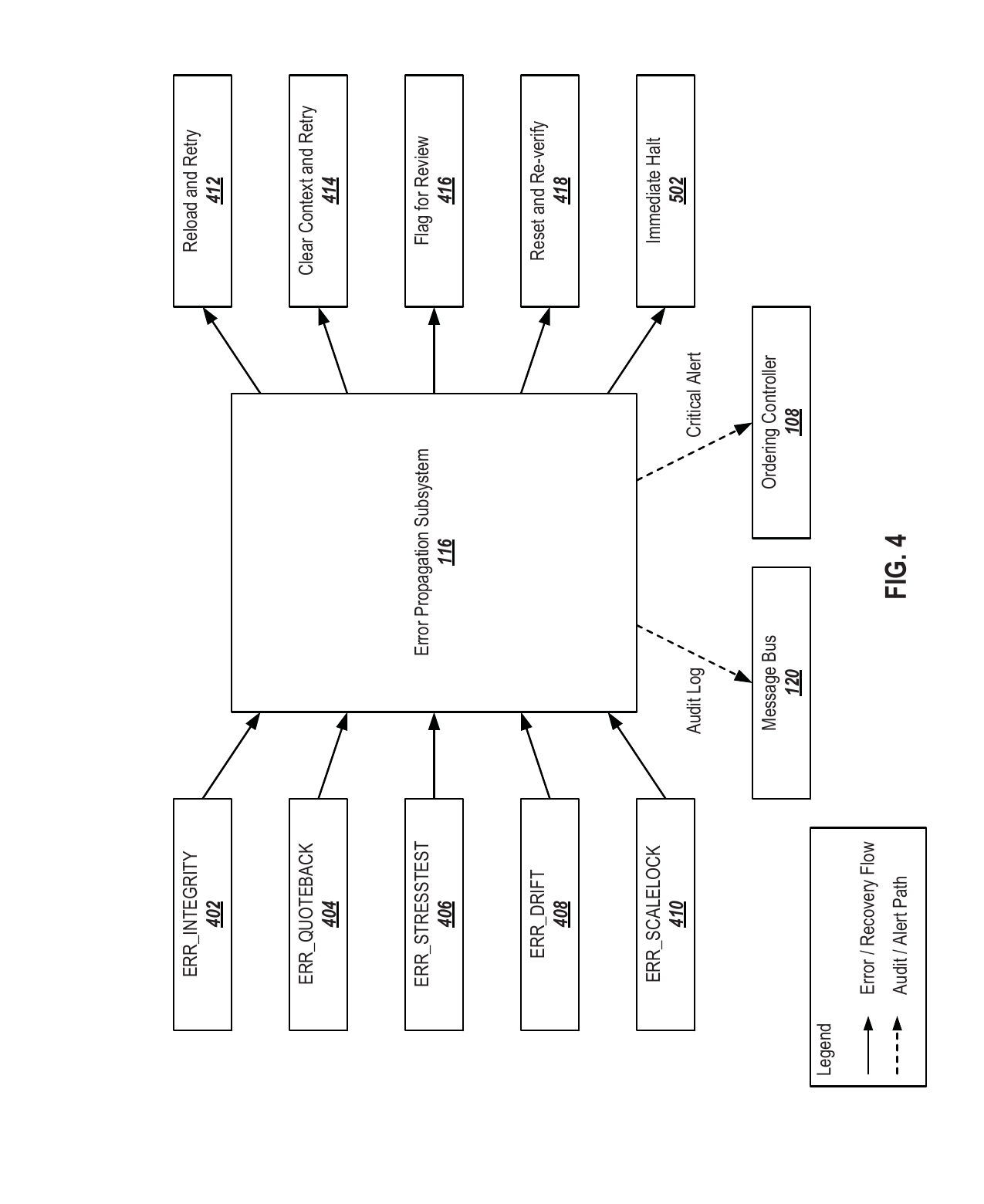
[0213]FIG. 4 is a block diagram illustrating example error and recovery pathways managed by an error propagation subsystem. In particular, FIG. 4 illustrates an architectural block diagram of the error and recovery pathways managed by the error propagation subsystem 116 to handle systematic anomalies and execute mitigation protocols in real-time. The example configuration includes a multi-input, multi-output routing topology where specific functional error codes feed directly into the error propagation subsystem 116 to trigger targeted recovery workflows along an error/recovery flow or an audit/alert path. The structure maintains absolute hardware-software isolation across the runtime execution pipeline 102, ensuring that any single subsystem exception can be programmatically contained before causing uncoordinated failures across the system.
[0214]The central processing hub shown in FIG. 4 is the error propagation subsystem 116, which operates as a real-time mathematical auditing, uncertainty tracking, and risk mitigation engine. The error propagation subsystem 116 can include specialized instruction logic and localized registers designed to ingest distinct exception identifiers generated across both the initialization pipeline 101 and the runtime execution pipeline 102. The error propagation subsystem 116 evaluates incoming failure severity metrics, tracks cumulative variance deltas, and cross-references the active system state to determine which specific recovery action or alert communication loop should be executed to protect the semantic and mathematical closure of the framework.
[0215]One input data stream connected to the error propagation subsystem 116 is the ERR_INTEGRITY stage 402, which intercepts and manages file-level initialization failures. The ERR_INTEGRITY stage 402 captures cryptographic validation discrepancies, structural schema mismatches, and truncation anomalies identified during the parsing of the FRAMEWORK_PACKAGE_HEADER within the compressed framework package 103. When an integrity failure is logged, the ERR_INTEGRITY stage 402 serializes the diagnostic packet, including the expected versus computed checksum parameters, and routes the transaction profile directly to the input layers of the error propagation subsystem 116.
[0216]Another input data stream connected to the error propagation subsystem 116 is the ERR_QUOTEBACK stage 404, which captures character-level fidelity violations during initial model verification. The ERR_QUOTEBACK stage 404 triggers whenever the external AI system 126 experiences an attention failure or token clipping that causes its generated output string to deviate from the verbatim reference text blocks required by the quote-back confirmation stage 204. The ERR_QUOTEBACK stage 404 packages the exact string index discrepancy and the base execution failure code into a structured exception payload, streaming this payload immediately into the error propagation subsystem 116 to flag the text ingestion failure.
[0217]Another input data stream connected to the error propagation subsystem 116 is the ERR_STRESSTEST stage 406, which registers mathematical and analytical computation exceptions. The ERR_STRESSTEST stage 406 activates when the external AI system 126 fails the range-verification loops executed over the holdout observables cataloged inside the FALSIFIABILITY_ANCHORS registry. If a model-generated physics prediction falls outside the explicit uncertainty tolerance bands or breaches the strict theoretical baseline error band where the ERR_STRESSTEST stage 406 compiles the calculation node provenance and variance failure metrics to stream a critical simulation exception directly to the error propagation subsystem 116.
[0218]Another input data stream connected to the error propagation subsystem 116 is the ERR_DRIFT stage 408, which monitors continuous linguistic usage anomalies during live reasoning operations. The ERR_DRIFT stage 408 ingests real-time notification alerts from the drift detection subsystem 114 whenever an output token sequence diverges from the canonical definitions stored within the registered lexicon 312 by more than a configurable similarity threshold. This input loop allows the error propagation subsystem 116 to receive continuous updates regarding slow, incremental divergence patterns before cumulative semantic drift can corrupt complex scientific derivations downstream.
[0219]Another input data stream connected to the error propagation subsystem 116 is the ERR_SCALELOCK stage 410, which registers physical invariant mutation violations. The ERR_SCALELOCK stage 410 captures transaction interception events from the scale enforcement subsystem 112 whenever the external AI system 126 attempts to adjust, modify, or add extraneous empirical parameters to a locked fundamental constant. The ERR_SCALELOCK stage 410 logs the unauthorized token assignment attempt alongside a precise timestamp and routes this parameter violation packet directly to the error propagation subsystem 116.
[0220]Branching from the upper control layers of the error propagation subsystem 116 is the reload and retry stage 412, which executes a low-level structural recovery flow. The reload and retry stage 412 is selected by the error propagation subsystem 116 when an ingestion anomaly is categorized as a transient file transfer error or a corrupt memory cache block. Upon activation, the reload and retry stage 412 bypasses active model context states to issue a hardware-level command that forces the loader subsystem 104 to completely re-ingest the compressed framework package 103, re-instantiating the file verification gateway from a clean baseline.
[0221]Another available output recovery path from the error propagation subsystem 116 is the clear context and retry stage 414, which manages volatile memory cleaning protocols. The clear context and retry stage 414 is programmatically deployed to mitigate intermediate text-matching or analytical calculation discrepancies that stem from context token saturation or attention misalignment. The clear context and rety stage 414 flushes the active inference memory buffer of the external AI system 126, purges cumulative rounding differences from the localized evaluation registers, and prompts a fresh token generation cycle to resolve transient processing faults without requiring a full system reboot.
[0222]Another available output recovery path from the error propagation subsystem 116 is the flag for review stage 416, which establishes a secure diagnostic hold state. The flag for review stage 416 is activated when the error propagation subsystem 116 encounters persistent semantic drift or uncalibrated parameter variances that cannot be resolved through automated loop regenerations. The flag for review stage 416 isolates the active processing session, encapsulates the complete historical trail of systemic exceptions, and saves the data packet to an immutable tracking registry for manual expert review, automated compliance auditing, or contract verification.
[0223]The next available output recovery path from the error propagation subsystem 116 is the reset and re-verify stage 418, which enforces a complete architectural validation cycle. The reset and re-verify stage 418 is invoked by the error propagation subsystem 116 when systemic framework discipline is compromised across multiple independent physical domains or pillars. The reset and re-verify stage 418 completely rolls back the operational state machine of the overall architecture, dropping the system out of its live runtime configuration and forcing the verification subsystem 106 to re-execute every multi-pass security gate inside the staged verification protocol 200.
[0224]Another output recovery path from the error propagation subsystem 116 is the immediate halt stage 420, which functions as the ultimate protective shutdown command. The immediate halt stage 420 is triggered when an incoming exception breaches a terminal safety boundary, such as a non-recoverable checksum error or an uncalibrated expansion that threatens to propagate hidden out-of-domain variables into the finalized verified output 124. The immediate halt stage 420 permanently terminates active token generation loops, suppresses all external application interface channels, and prevents any unverified calculations from being released to downstream client nodes.
[0225]Communicatively coupled to the error propagation subsystem 116 via a dashed audit/alert path is the message bus 120, which serves as the asynchronous communication backbone and recording layer for the architecture. When any input exception code is processed or any output recovery strategy is executed, the error propagation subsystem 116 automatically generates a structured, machine-readable uncertainty record containing a unique transaction tag, a precise timestamp, and localized variance scores. This data packet is streamed directly over the decoupled event layer to the message bus 120, which commits the fields to a tamper-resistant audit log within non-transitory computer-readable storage to provide a legally defensible forensic trail.
[0226]As described above, the ordering controller 108, which handles high-level state governance and transition management. The error propagation subsystem 116 maintains an explicit communication link to the ordering controller 108 via a dedicated critical alert path. If the accumulated relative variance across sequential calculation nodes breaches the strict theoretical baseline error band or if an automated retry boundary is exceeded, the error propagation subsystem 116 bypasses intermediate processing blocks to transmit a programmatic critical alert message directly to the ordering controller 108. Receiving this master exception signal, the ordering controller 108 instantly suppresses the active execution triggers, drops the operational environment into the designated unverified error state 708, and locks down the runtime execution pipeline 102 until safety integrity is restored.