6. Drift Detection
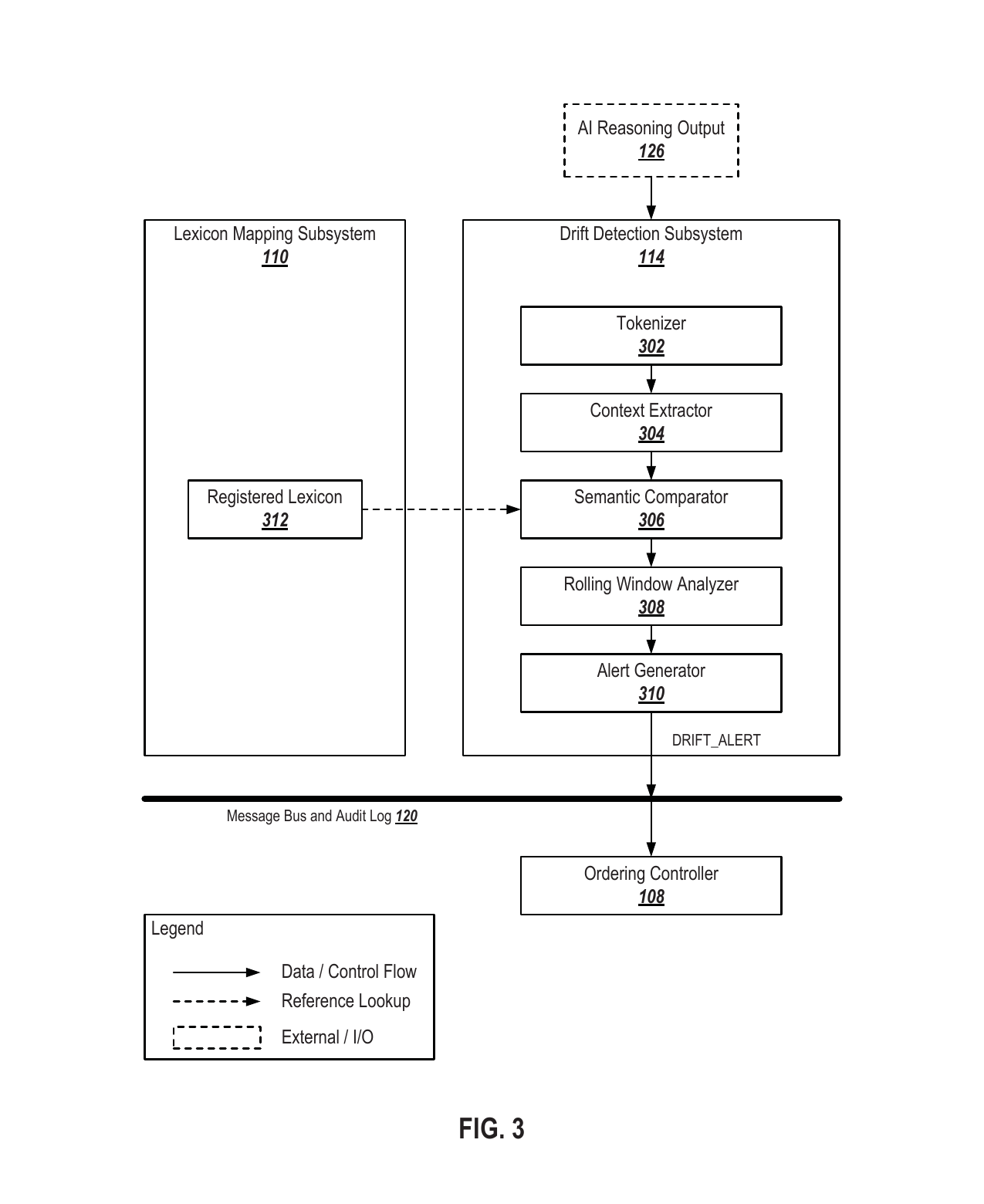
[0202]FIG. 3 is a block diagram illustrating an example drift detection subsystem 114 and its architectural interactions within the runtime execution pipeline 102 to detect, track, and suppress terminology deviations in real-time during model execution. The entry point for text analysis within the drift detection layout of FIG. 3 is the AI reasoning output 127, which includes an external interface or memory buffer containing raw data transactions generated by the external AI system 126. The AI reasoning output 127 represents the raw, nascent token streams, mathematical progressions, and text generations outputted live by the external AI system 127 during active inference cycles. Rather than being delivered directly or unrestrictedly to a user interface or downstream application node, these nascent tokens are continuously captured and routed through background monitoring filters. The AI reasoning output 127 provides the initial unstructured or semi-structured data transaction stream that undergoes semantic tracking to ensure it remains strictly bounded within the rigid conceptual constraints of the underlying framework package.
[0203]The lexicon mapping subsystem 110 is communicatively coupled to the drift detection subsystem 114 to provide initial terminology stabilization and translation management. Operating as a real-time terminology conversion and contextual enforcement engine within the runtime execution pipeline 102, the lexicon mapping subsystem 110 processes the raw text transactions from the AI query or input 122 or the nascent token streams from the AI reasoning output 127. The lexicon mapping subsystem 110 evaluates the bidirectional translation boolean flags embedded within each registry record to determine whether an intercepted term operates symmetrically or asymmetrically across vocabulary frameworks. For output operations, as the external AI system 126 generates response strings, the lexicon mapping subsystem 110 scans the live tokens to perform reverse-substitutions, converting complex framework primitives back into user-friendly legacy expressions to facilitate clear, human-readable expert review without sacrificing precision. The lexicon mapping subsystem 110 outputs a normalized, term-stabilized token stream that is routed to the drift detection subsystem 114, ensuring that subsequent statistical tokenization filters act on a stabilized vocabulary distribution.
[0204]The registered lexicon 312 is a core registry data structure accessible by both the lexicon mapping subsystem 110 and the drift detection subsystem 114 to provide a persistent, unalterable semantic baseline. The registered lexicon 312 includes the serialized LEXICON_MAP array extracted from the compressed framework package 103 by the loader subsystem 104 during initialization. Structurally organized as an in-memory database lookup table, an associative array, or a persistent addressable memory segment, the registered lexicon 312 houses an ordered list of registered terms, canonical framework primitive identifiers, legacy terminology aliases, authoritative definition strings, and bidirectional translation boolean flags. In a VMS framework application, the registered lexicon 312 establishes explicit associative pairs linking legacy technical expressions like “particle”, “force”, “charge”, and “mass” directly to their underlying geometric loop primitives like “stable closed harmonic loop”, “gradient of missing-space profile”, “orientation-gated effect of a rotating loop”, and “integrated display-area action of a closed loop”. The registered lexicon 312 exposes an interactive lexicon reference lookup path to the drift detection subsystem 114, serving as the ground-truth benchmark against which active token usage context is measured.
[0205]The drift detection subsystem 114 operates as a real-time semantic monitoring, token analysis, and statistical validation engine within the runtime execution pipeline 102. The drift detection subsystem 114 receives the term-stabilized token stream from the lexicon mapping subsystem 110 alongside registered definition matrices from the registered lexicon 312. The drift detection subsystem 114 is configured to detect and suppress cumulative semantic drift, which manifests as a gradual deviation in the meaning or application of foundational terms over a succession of sequential reasoning steps or long text generations. AI models exhibit an inherent machine flaw where long text generations cause them to gradually substitute pre-trained baseline statistical biases or associations for precise framework definitions, leading to automated hallucinations and reasoning errors. To execute a continuous token-level audit without decreasing host processing speed, the drift detection subsystem 114 orchestrates a dedicated physical and functional module pipeline that includes a tokenizer 302, a context extractor 304, a semantic comparator 306, a rolling window analyzer 308, and an alert generator 310.
[0206]The tokenizer 302 defines the front-end linguistic processing module inside the drift detection subsystem 114, receiving the incoming term-stabilized token stream from the lexicon mapping subsystem 110. The hardware processors executing the tokenizer 302 run an analytical tokenization workflow that segments the output text structures into discrete, machine-addressable word forms, symbols, alphanumeric hashes, and linguistic sub-word units. Rather than performing basic whitespace string splitting, the tokenizer 302 strips formatting anomalies and isolates individual primitive identifiers to prepare them for relational structural analysis. The tokenizer 302 outputs an ordered vector of parsed token entities and sub-word units, streaming this structured textual matrix directly to the context extractor 304 to establish the positional syntax boundaries of each term within the generation stream.
[0207]The context extractor 304 receives the ordered vector of parsed token entities from the tokenizer 302 and isolates the semantic environment surrounding each designated primitive term. The hardware processors executing the context extractor 304 maintain a localized lookahead and lookback buffer to capture a precise context window, which includes a fixed block of tokens preceding and succeeding an intercepted target primitive within the text generation stream. The context extractor 304 parses adjacent adjectives, dependent mathematical operations, conditional operators, and domain-specific variables to compile an active usage context vector for the term. This active usage context vector represents the localized statistical and logical environment in which the external AI system 126 has applied the framework primitive, and it is passed immediately to the semantic comparator 306.
[0208]The semantic comparator 306 executes continuous natural language comparisons and numerical vector-distance routines within the drift detection subsystem 114. The semantic comparator 306 receives the active usage context vector from the context extractor 304 and simultaneously invokes the lexicon reference path from the registered lexicon 312 to fetch the corresponding canonical definition string and authoritative constraints for the designated term. The hardware processors of the semantic comparator 306 evaluate the active usage context against the registered definition by computing a mathematical similarity metric, such as a cosine distance or semantic embedding similarity score. If the computed similarity metric indicates that the term’s active usage remains aligned with its authoritative constraint, the calculation passes. However, if the context diverges from its registered definition by more than a configurable similarity threshold, the semantic comparator 306 flags the deviation, records the precise localized variance metric, and forwards the divergence delta to the rolling window analyzer 308.
[0209]The rolling window analyzer 308 receives the localized variance metrics from the semantic comparator 306 to execute multi-step trend analysis across the text generation history. Because semantic drift frequently manifests not as a sudden single-token failure but as a slow, incremental divergence pattern over a succession of consecutive reasoning layers, the rolling window analyzer 308 implements lexicon locking by maintaining a usage frequency table and an analytical history tracking matrix. The rolling window analyzer 308 tracks the cumulative drift score and frequency metrics across a sliding window of sequential tokens or derivation steps. By evaluating these incremental divergence trends, the rolling window analyzer 308 is configured to catch slow, creeping deviations where the external AI system 126 gradually substitutes pre-trained baseline statistical biases or associations for precise framework definitions. When the accumulated drift score across the designated sliding window breaches a configured system tolerance threshold, the rolling window analyzer 308 passes an activation signal to the alert generator 310.
[0210]The alert generator 310 operates as the enforcement trigger and communication gateway of the drift detection subsystem 114. Upon receiving an activation signal from the rolling window analyzer 308 indicating an uncalibrated semantic shift, the alert generator 310 triggers an enforcement action to protect downstream reasoning environments. The alert generator 310 instantly constructs a telemetry data packet designated as a DRIFT_ALERT. This DRIFT_ALERT data packet includes specific transaction metadata, including a unique drift identifier tag, a timestamp, the exact term experiencing the deviation, the registered definition, the computed context variance score, and the active token sequence. The alert generator 310 publishes this DRIFT_ALERT signal out of the drift detection subsystem 114, routing it concurrently to the message bus and audit log 120 and the ordering controller 108 to initiate automated mitigation routines.
[0211]The message bus and audit log 120 operates as an asynchronous communication backbone, event broker, and persistent recording layer spanning the pipelines of the architecture. In the context of FIG. 3, the message bus and audit log 120 receives the continuous stream of real-time telemetry data packets and DRIFT_ALERT signals broadcast by the alert generator 310. Processing these incoming data packets, the message bus and audit log 120 executes asynchronous queue management, metadata ingestion, and serialization routines to bind each transaction to a unique, immutable timestamp and context tag. Simultaneously, the message bus and audit log 120 structures and commits these compiled data fields to a non-transitory computer-readable storage matrix, outputting a machine-readable, tamper-resistant audit record that transforms unstructured interactions into technically bounded and legally defensible verification datasets.
[0212]The ordering controller 108 completes the enforcement loop of FIG. 3, operating as a deterministic state machine and execution governance layer across the system. The ordering controller 108 is communicatively coupled to the message bus and audit log 120 to ingest the compiled drift telemetry and DRIFT_ALERT control signals. Upon interception of a drift notification, the ordering controller 108 is programmed to dynamically execute automated recovery loops, switch internal system states, or execute a protective halt. Depending on the severity of the semantic shift recorded in the telemetry packet, the ordering controller 108 may transmit an automated instruction to dump the active context window of the external AI system 126, transition the runtime environment into an unverified error state 708 (FIG. 7), or optionally halt reasoning pending independent human review, thereby preventing uncoordinated subsystem failures from compromising system accuracy.