5. Staged Verification Protocol
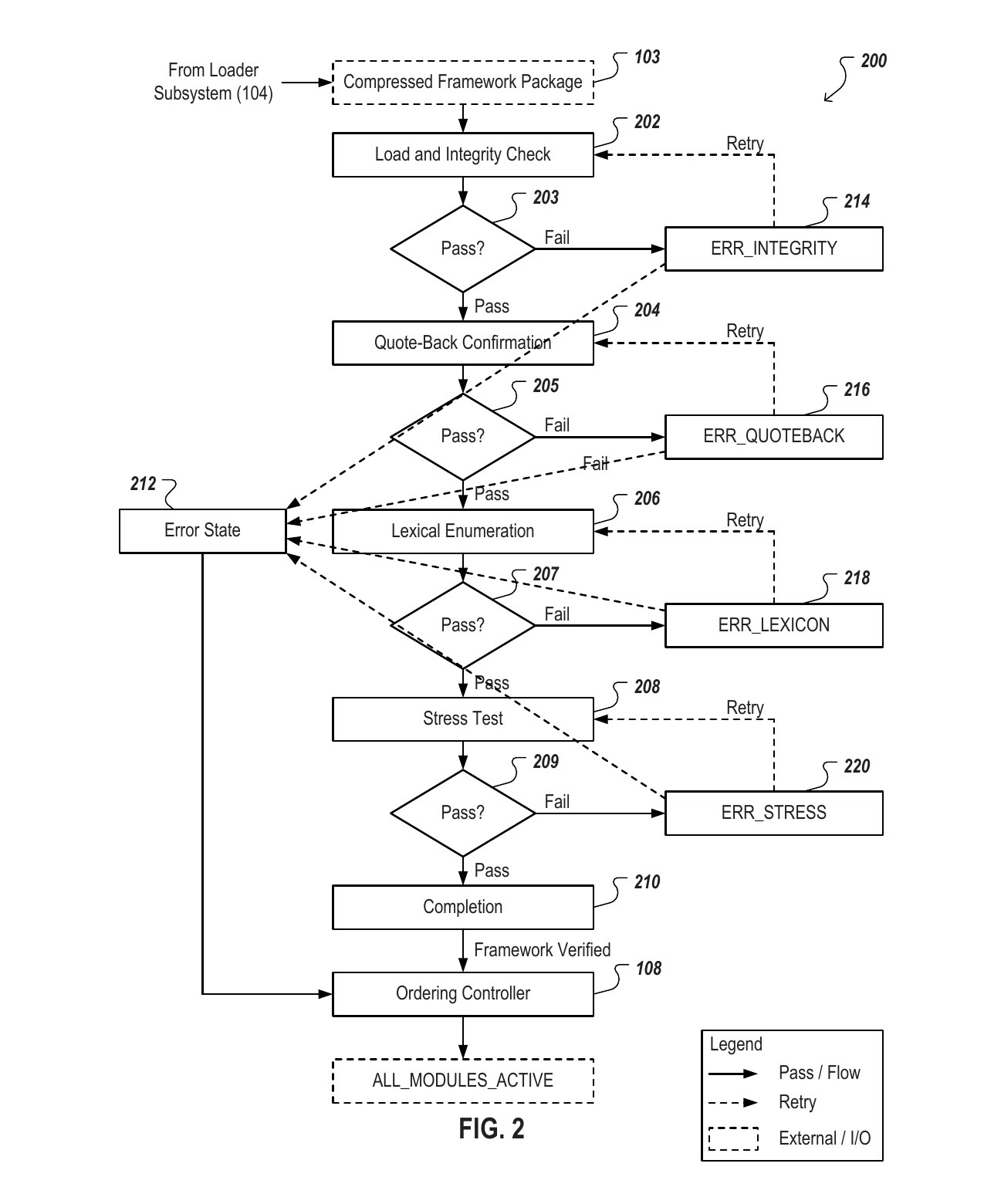
[0182]FIG. 2 is a flowchart illustrating an example staged verification protocol 200 that includes sequential validation checks and error state triggers. The staged verification protocol 200 can be executed by the verification subsystem 106 within the initialization pipeline 101 of FIG. 1B.
[0183]The staged verification protocol 200 is configured to establish an unalterable, automated testbed that audits the data ingestion fidelity of a target AI model before enabling downstream reasoning operations. This gatekeeping protocol specifically counteracts the computer-specific machine flaw where neural networks prematurely claim complete file ingestion or substitute pre-trained baseline statistical biases for precise framework constraints. Guided by the programmatic instructions embedded in the VERIFICATION_PROTOCOL metadata block of the compressed framework package 103 of FIG. 1A, the staged verification protocol 200 enforces a rigid sequence of multi-pass validation gates managed dynamically by the ordering controller 108.
[0184]The load and integrity check stage 202 acts as the initial operational validation gate within the staged verification protocol 200, receiving the compressed framework package 103 from the loader subsystem 104. Upon ingestion, the hardware processors executing the load and integrity check stage 202 read the compressed framework package 103 to parse its hierarchical structural schema. The load and integrity check stage 202 automatically isolates the global package header, designated as the FRAMEWORK_PACKAGE_HEADER, to extract structural metadata attributes including the schema version identifier, the unique package identifier, and the total file byte length indicator. This mapping sequence ensures that the basic file constraints match the hardware configuration expectations of the system before any deeper token parsing or neural execution steps are allowed to modify the machine state.
[0185]In addition to structural mapping, the load and integrity check stage 202 executes an automated cryptographic verification routine to validate the authenticity and completeness of the incoming file. The load and integrity check stage 202 extracts the checksum type definition, such as a SHA256 configuration, and the pre-computed byte-stream checksum value stored within the validation block of the compressed framework package 103. The hardware processors executing the load and integrity check stage 202 then run a localized hashing loop over the entirety of the packaged serialized arrays to compute a live runtime checksum value. This computed value is matched directly against the pre-compiled embedded checksum value via a hardware comparator loop to determine if the compressed framework package 103 has experienced any file-level corruption, truncation, or unauthorized data tampering during transit.
[0186]A pass/fail stage 203 determines whether the load and integrity check was passed successfully. The load and integrity check passes successfully when the locally computed cryptographic checksum matches the pre-compiled embedded checksum value within the validation block of the compressed framework package 103 exactly, and the structural metadata attributes within the global package header are verified as complete. When a successful match is determined at the pass/fail stage 203, the control flow transitions along the primary execution pathway to the quote-back confirmation stage 204 to initiate text-level fidelity verification. This positive state transition confirms the end-to-end data integrity of the ingested file, allowing the verification subsystem 106 to safely advance AI model to the next sequential validation gate without risking the processing of corrupted or truncated data string.
[0187]Conversely, if the computed checksum diverges from the embedded verification target or if the structural header parsing encounters a data anomaly, the pass/fail stage 203 evaluates the condition as a failure and routes the operational data flow to the ERR_INTEGRITY stage 214. At the ERR_INTEGRITY stage 214, the staged verification protocol 200 logs the specific validation exception to record the file-level failure. The ERR_INTEGRITY stage 214 then initiates an automated retry path that loops back up to the load and integrity check stage 202 to re-attempt file stream ingestion and clear transient data transfer errors. If the pre-configured retry limits are exceeded or the file corruption is determined to be non-recoverable, the exception status is routed from the ERR_INTEGRITY stage 214 directly to the error state stage 212. The error state stage 212 suppresses downstream activation and transmits a critical validation failure alert to the ordering controller 108 to transition the architecture into an authorized lockout configuration.
[0188]The quote-back confirmation stage 204 receives the operational control flow from the pass/fail stage 203 upon a successful validation determination at the load and integrity check stage 202. The quote-back confirmation stage 204 acts as a text-level fidelity barrier to verify character-level ingestion accuracy within the active context memory window of the external AI system 126. The hardware processors executing the quote-back confirmation stage 204 transmit a programmatic instruction string to the external AI system 126, requesting the verbatim reproduction of specified framework text blocks or metadata fields defined within the VERIFICATION_PROTOCOL block of the compressed framework package 103. For example, in a VMS framework application, the quote-back confirmation stage 204 instructs the external AI system 126 to reproduce verbatim a designated sequence of lines from the primitive definitions metadata block, such as the first N lines and last N lines of the framework package, to explicitly confirm token-level transmission fidelity without clipping or statistical dilution.
[0189]As the external AI system 126 processes the verification instruction, the external AI system 126 generates a response string representing the requested text block. The hardware processors executing the quote-back confirmation stage 204 capture and intercept this model-generated response string within a localized evaluation buffer before any downstream reasoning layers are permitted to activate. The quote-back confirmation stage 204 then maps the generated text string metrics directly to the conditional pass/fail stage 205 to evaluate character-level match compliance. This detailed text audit directly targets the computer-specific processing deficiency where statistical language models falsely claim complete processing of an extended file while substituting pre-trained statistical weights for precise framework constraints. By converting the abstract token generation of the external AI system 126 into a strict, character-by-character memory verification step, the quote-back confirmation stage 204 guarantees absolute semantic alignment before the staged verification protocol 200 permits any further validation progression.
[0190]The pass/fail stage 205 determines whether the character-level text reproduction executed during the quote-back confirmation stage 204 was passed successfully by the external AI system 126. The quote-back confirmation passes successfully at the pass/fail stage 205 when the response string generated by the external AI system 126 is a character-for-character match against the target framework text blocks extracted from the compressed framework package 103. When a successful exact match is determined at the pass/fail stage 205, the control flow transitions along the primary execution pathway via a PASS branch to the lexical enumeration stage 206. This positive transition confirms that the internal attention mechanisms of the external AI system 126 have ingested the core text bounds without truncation or informational loss, clearing the pipeline to proceed to structural semantic auditing.
[0191]Conversely, if the text-matching array detects even a single character deviation, missing punctuation mark, transposed token, or whitespace anomaly within the generated output string, the pass/fail stage 205 evaluates the condition as a failure. Upon a failure determination, the pass/fail stage 205 routes the operational data flow horizontally along a FAIL branch out of the main execution pathway to the ERR_QUOTEBACK stage 216. At the ERR_QUOTEBACK stage 216, the staged verification protocol 200 logs the specific character-level mismatch and records the baseline execution failure code. The ERR_QUOTEBACK stage 216 then triggers an automated retry path that loops back up to the quote-back confirmation stage 204 to prompt a re-generation of the specified text block, effectively mitigating transient processing faults or context placement errors. If the automated retry cycles fail to resolve the deviation or exceed a pre-configured maximum attempt threshold, the validation failure status is routed from the ERR_QUOTEBACK stage 216 directly to the error state stage 212, which permanently locks down downstream application layers and passes a critical validation failure alert to the ordering controller 108.
[0192]The lexical enumeration stage 206 receives the operational control flow from the pass/fail stage 205 along the primary vertical execution pathway upon a successful validation determination at the quote-back confirmation stage 204. The lexical enumeration stage 206 evaluates the structural and logical alignment of the framework's internal semantic graph within the context memory window of the external AI system 126. The hardware processors executing the lexical enumeration stage 206 issue programmatic instructions directing the external AI system 126 to systematically extract the primitive records, enumerate all registered primitives alongside their exact definitions, and map out the complete dependency pathways leading back to the calibration anchors. This operation forces the external AI system 126 to demonstrate that it has accurately captured the relational cross-references and topology integers, such as winding numbers, linking numbers, and torsion invariants, that define the foundational geometric entities of the framework. Furthermore, the lexical enumeration stage 206 causes the external AI system 126 to execute dimensional analysis and verify loop quantization conditions across multiple physical pillars to confirm cross-domain consistency. The compiled architectural tracing metrics and semantic mapping records are then routed directly to the conditional pass/fail stage 207 to execute a structural alignment evaluation.
[0193]The pass/fail stage 207 determines whether the structural semantic graph and dimensional tracking records generated during the lexical enumeration stage 206 were passed successfully by the external AI system 126. The lexical enumeration passes successfully at the pass/fail stage 207 when the cross-domain dimensional checks and primitive mappings generated by the external AI system 126 match the registered constraints and dependency pathways of the compressed framework package 103 exactly. When a successful structural alignment is determined at the pass/fail stage 207, the control flow transitions along the primary vertical execution pathway via a PASS branch to the stress test stage 208 to initiate analytical physics validation.
[0194]Conversely, if the tracing path uncovers a logical mismatch, an unregistered alias definition, or a dimensional inconsistency when linking distinct domains, the pass/fail stage 207 evaluates the condition as a failure. Upon a failure determination, the pass/fail stage 207 routes the operational data flow along a FAIL branch out of the main execution pathway to the ERR_LEXICON stage 218. At the ERR_LEXICON stage 218, the staged verification protocol 200 logs the specific vocabulary deviation, missing cross-reference pointer, or unit contradiction to record the mapping exception. The ERR_LEXICON stage 218 then executes an automated retry path that loops back up to the lexical enumeration stage 206 to prompt a re-enumeration and resolve transient semantic graph tracking errors. If the automated retry cycles fail to reconcile the structural deviation or exceed a pre-configured maximum attempt threshold, the validation failure status is routed from the ERR_LEXICON stage 218 directly to the error state stage 212 to initiate a protective architectural lockout.
[0195]The stress test stage 208 receives the operational control flow from the pass/fail stage 207 along the primary execution pathway upon a successful validation determination at the lexical enumeration stage 206. The stress test stage 208 audits the operational performance, mathematical capabilities, and analytical accuracy of the external AI system 126 under strict simulation rules to ensure framework compliance. The hardware processors executing the stress test stage 208 invoke the falsifiability anchors registry compiled from the compressed framework package 103 to isolate a selection of pre-registered holdout observables. The stress test stage 208 then directs the external AI system 126 to apply the framework’s dependency graph of validated equations, e.g., the 31 validated equations from identifier tags F0001 through F0031 in a VMS framework application, to independently compute target numerical physics predictions for these specified physical properties across a plurality of distinct pillars or domains of the framework.
[0196]During this simulation routine, the external AI system 126 executes complex, multi-step calculation sequences within its local context window without requiring external host database connections or experiencing cumulative arithmetic drift. As the external AI system 126 completes these analytical updates, the hardware processors executing the stress test stage 208 capture the resulting computed numerical predictions, unit outputs, and intermediate derivation steps. The stress test stage 208 compiles these model-generated physical constants and variables within a localized evaluation register. The stress test stage 208 then maps the accumulated calculation data directly downstream to the conditional pass/fail stage 209 to drive a precision range-verification loop against the explicit uncertainty tolerance bands. This rigorous operational audit ensures that the external AI system 126 can successfully generate well-calibrated physical extensions that match peer-reviewed empirical realities before the staged verification protocol 200 permits a transition into an authorized runtime configuration.
[0197]The pass/fail stage 209 determines whether the analytical physics predictions and multi-step calculations executed during the stress test stage 208 were passed successfully by the external AI system 126. The stress test passes successfully at the pass/fail stage 209 when the model-generated numerical predictions, unit outputs, and physical variables fall strictly within the lower and upper bounds defined by the explicit uncertainty tolerance bands stored inside the FALSIFIABILITY_ANCHORS block of the compressed framework package 103. Specifically, in a VMS framework application, the pass/fail stage 209 enforces a strict theoretical baseline error band where Jc = ±0.01% over target holdout observables such as the hydrogen Balmer alpha wavelength and, the muon mass. When a successful range evaluation is determined for all target observables at the pass/fail stage 209, the operational control flow transitions vertically along the primary execution pathway via a PASS branch to the completion stage 210 to conclude the startup sequence. This positive transition confirms that the external AI system 126 can perform high-fidelity, deep scientific reasoning across independent physical pillars without experiencing cumulative arithmetic drift or generating uncalibrated, hallucinated extrapolations.
[0198]Conversely, if any calculated prediction or derived physical constant falls outside its designated uncertainty tolerance band, or if the calculation breaches the strict Jc = ±0.01% threshold, the pass/fail stage 209 evaluates the condition as a failure. Upon a failure determination, the pass/fail stage 209 routes the operational data flow horizontally along a FAIL branch out of the main execution pathway to the ERR_STRESS stage 220. At the ERR_STRESS stage 220, the staged verification protocol 200 logs the specific analytical deviation, calculation node provenance, and variance failure metrics to capture the simulation exception. The ERR_STRESS stage 220 then executes an automated retry path that loops back up to the stress test stage 208 to clear temporary calculation anomalies or reset context memory tracking structures. If the automated retry cycles fail to bring the model-generated outputs within the allowed tolerance band or exceed a pre-configured maximum attempt threshold, the validation failure status is routed from the ERR_STRESS stage 220 directly to the error state stage 212. The error state stage 212 isolates the active tracking infrastructure, permanently suppresses the activation of downstream monitoring modules, and transmits a critical validation failure alert to the ordering controller 108 to switch the system into a protective lockout phase.
[0199]The completion stage 210 receives the operational control flow from the pass/fail stage 209 along the primary vertical execution pathway upon a successful validation determination at the stress test stage 208. The completion stage 210 acts as the final administrative compilation node of the staged verification protocol 200, concluding the initialized startup sequence of the framework. The hardware processors executing the completion stage 210 compile the successful validation logs from each of the preceding validation gates, write persistent verification pass markers to the local tracking registries, and finalize the in-memory validation parameters. Once all administrative logs are structured and committed, the completion stage 210 generates a final programmatic control signal designated as FRAMEWORK_VERIFIED and transmits this signal directly downstream to the ordering controller 108 to signal that the underlying knowledge base is completely established.
[0200]Upon receiving the FRAMEWORK_VERIFIED control signal from the completion stage 210, the ordering controller 108 formally executes an internal state transition to lift the initial protective lockout phase and change operational configurations. The ordering controller 108 transitions the architecture out of a pending load phase and into the authorized “Framework Verified” state 704 (FIG. 7), confirming that the external AI system 126 is losslessly bounded with absolute informational fidelity. To unlock live reasoning operations, the ordering controller 108 generates and broadcasts a specific programmatic control command designated as the ALL_MODULES_ACTIVE output signal. This ALL_MODULES_ACTIVE signal acts as the master execution trigger that switches the operational state of the background governance modules, including the lexicon mapping subsystem 110, the scale enforcement subsystem 112, the drift detection subsystem 114, the error propagation subsystem 116, and the domain boundary subsystem 118, from an inactive configuration to a live monitoring configuration to begin intercepting and validating active data transactions within the runtime execution pipeline 102.
[0201]The error state stage 212 is positioned within the flowchart of FIG. 2 as the universal fail-safe terminal for all horizontal exception pathways, intercepting permanent validation failures flagged across the initialization pipeline 101. The error state stage 212 captures the terminal failure status routed from the ERR_INTEGRITY stage 214, the ERR_QUOTEBACK stage 216, the ERR_LEXICON stage 218, or the ERR_STRESS stage 220 when automated retry boundaries are exceeded. The hardware processors executing the error state stage 212 immediately halt the progression of the staged verification protocol 200, isolate the active context memory tracking structures, and permanently suppress the generation of the ALL_MODULES_ACTIVE master trigger to prevent the premature activation of unverified downstream components. The error state stage 212 compiles the localized failure metrics into an exception data packet and transmits a critical validation failure alert directly to the ordering controller 108. This protective communication drops the overall architecture into a designated unverified error state, forcing the system to maintain rigid hardware-software isolation until manual human review or a full system reset clears the tracking infrastructure.