4. System Overview: Preparation Pipeline, Runtime Layer and Package Format
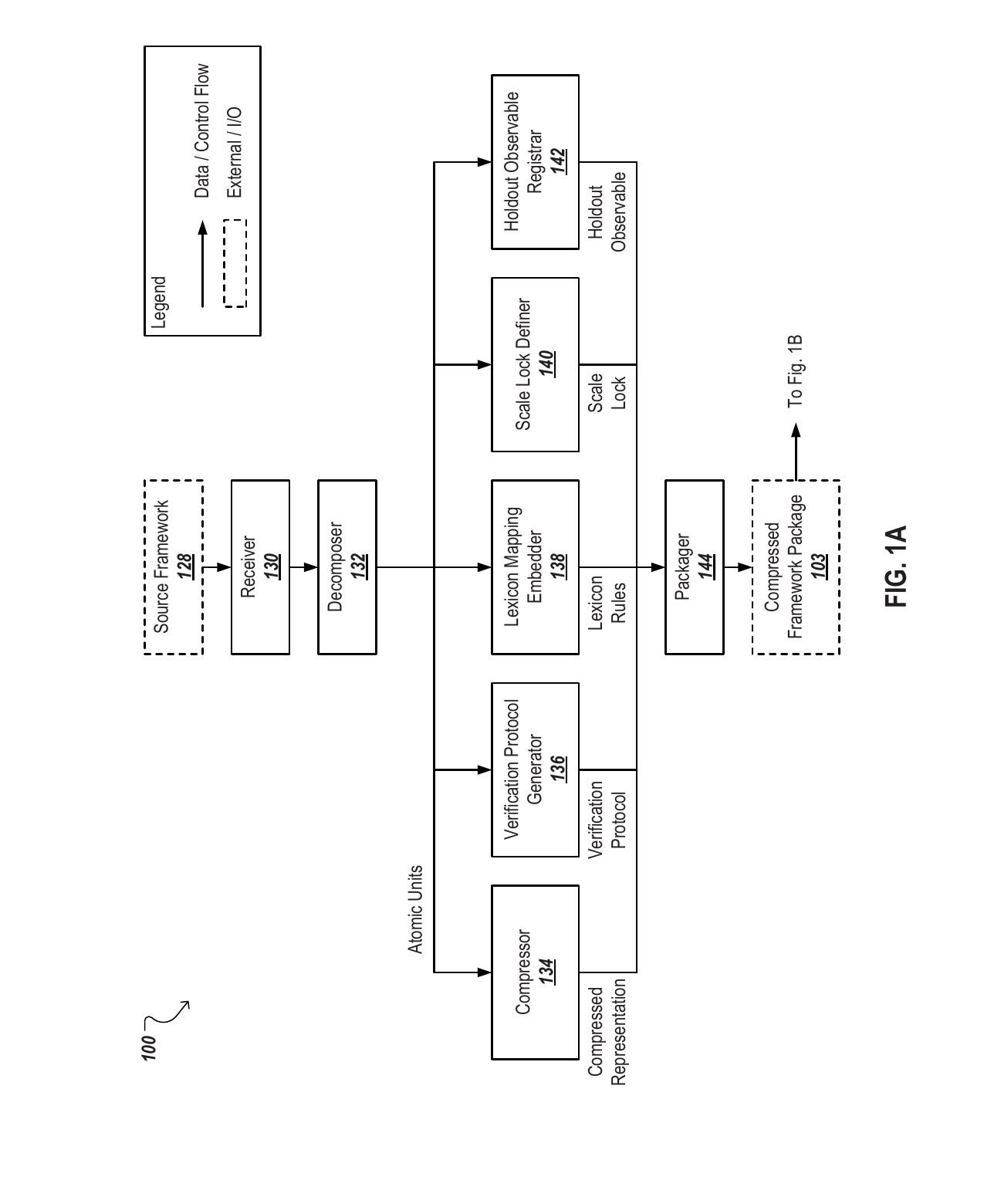
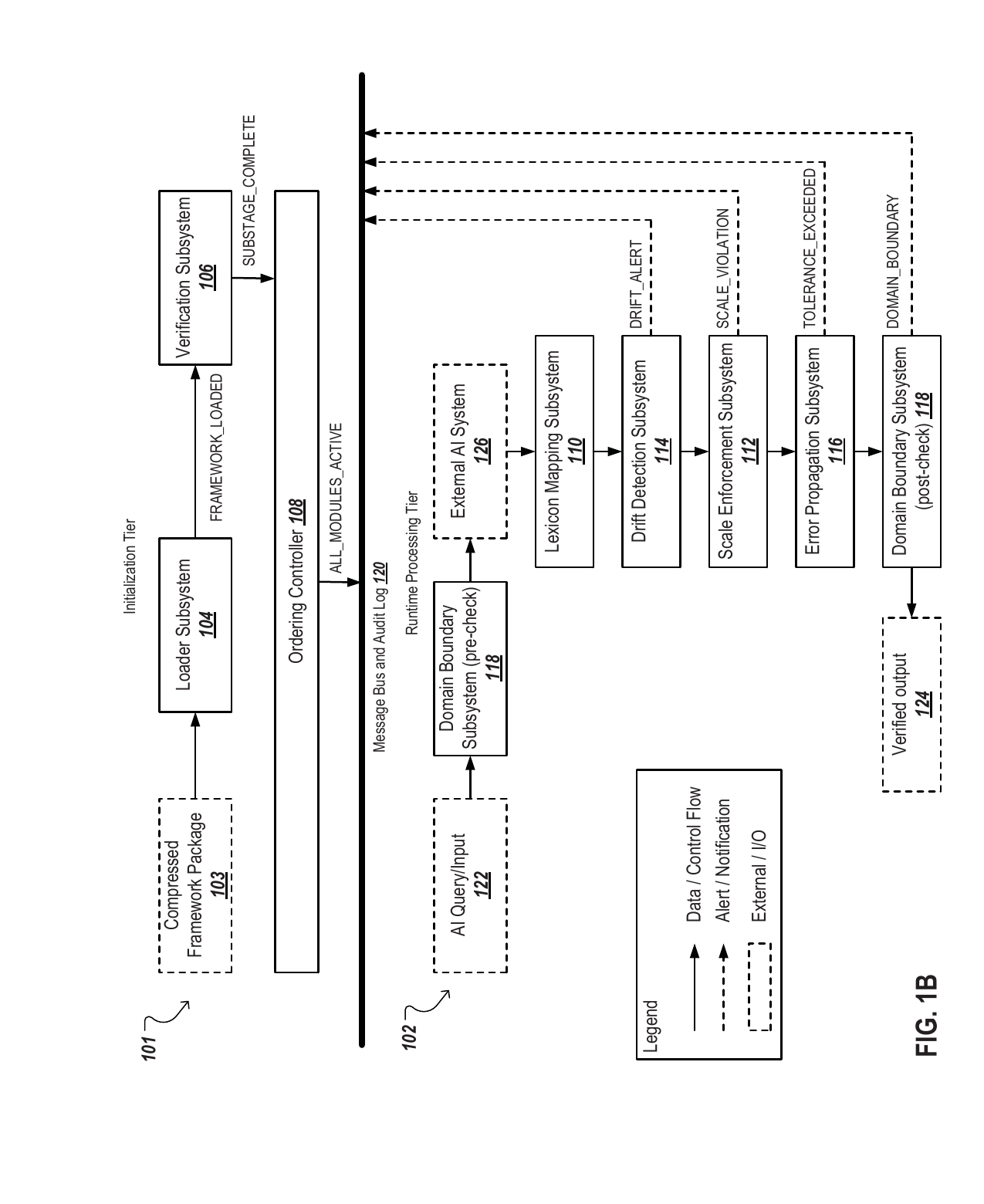
[0104]FIGs. 1A and 1B illustrate a system that coordinates framework ingestion and runtime execution of an AI model. In particular, FIG. 1A shows the preparation pipeline 100 and FIG. 1B shows the initialization pipeline 101 and the runtime execution pipeline 102. These pipelines 100-102 include various components of an overall system, which can be implemented in one or more computers in one or more locations. For example, each pipeline can be implemented on a dedicated computer or computers, which can be in different locations than the computer(s) for one or both of the other pipelines. In other examples, all pipelines can be implemented using the same computer or any combination of components of pipelines can be implemented in different combinations of computers.
[0105]FIG. 1A illustrates an architectural block diagram of the preparation pipeline 100 configured to ingest a raw source framework 128 and transform it into a self-sufficient, machine-readable compressed framework package 103. The preparation pipeline 100 is executed by one or more physical hardware processors accessing a non-transitory computer-readable memory matrix containing specialized execution instructions. To prevent semantic distortion, mathematical drift, and algorithmic hallucinations within downstream AI reasoning environments, the preparation pipeline 100 transforms abstract semantic and formulaic expressions into a rigid, topologically anchored, and hardware-addressable data block configuration. This processing layout may be implemented within a single localized server infrastructure, a distributed computing network, an independent hardware development node, or a secure cloud-based data environment.
[0106]The preparation pipeline 100 of the system operates as an automated ingest and preprocessing pipeline for complex frameworks. In general, the preparation pipeline 100 converts a raw source framework 128, e.g., a structured knowledge framework, into an optimized, machine-readable data package. This conversion process safeguards the structural and mathematical integrity of complex frameworks before the data interacts with downstream reasoning engines. The preparation pipeline 100 accomplishes this by breaking down a global framework into typed atomic records. These records are then compressed, verified, and bounded, e.g., simultaneously, by continuous computational guardrails. The final output is a secure, self-sufficient compressed framework package 103. This package 103 is uniquely optimized, or at least enhanced, for ingestion by an AI model.
[0107]To achieve this structural conversion, the system passes the source data of the framework 128 through a multi-channel preparation pipeline 100 that includes a receiver 130, a decomposer 132, a compressor 134, a verification protocol generator 136, a lexicon mapping embedder 138, a scale lock definer 140, a holdout observable registrar 142, and a packager 144. The preparation pipeline 100 isolates core elements of the incoming knowledge base into distinct operational data blocks. These blocks map relationships among foundational geometric primitives across multiple physical domains or pillars. The preparation pipeline 100 losslessly compresses the mathematical expressions to reduce active memory footprint. The preparation pipeline 100 embeds custom translation layers, hardwired scale settings, and pre-calculated verification anchors directly into the serialized file configuration. In some implementations, the preparation pipeline 100 signs the finished package using a cryptographic signature. This signature ensures end-to-end data validation and prevents file-level corruption during transmission, e.g., from the preparation pipeline 100 to the initialization pipeline 101. The formatted data package enables downstream intelligence networks to reason with the scientific framework without experiencing semantic drift or reasoning errors.
[0108]The source framework 128 is a structured knowledge framework that organizes complex scientific and technical domain knowledge for deterministic machine parsing, e.g., deterministic machine parsing. The source framework 128 can be structured as a serialized text file, a JSON data file, an XML data file, or another appropriate type of data structure. In some implementations, the source framework 128 is structured as an uncompressed local or cloud-hosted database stored on storage devices across multiple physical locations. The internal data architecture of the source framework 128 can include primitive definitions, relationships among primitives, derivation chains, calibration anchors, domain boundaries, and/or falsifiability anchors. Depending on the actual framework, the source framework 128 can include any combination of these types of data. The preparation pipeline 100 ingests this structured data format to isolate core elements of the incoming knowledge base into distinct operational data blocks before interaction with downstream AI models.
[0109]The source framework 128 can include a primitives component to define atomic foundational units that have no further decomposition within the underlying model. The primitives component includes, e.g., stores, multiple typed records that contain unique identifiers, definition strings, legacy terminology aliases, and topology integers. The topology integers explicitly record winding numbers, linking numbers, and/or torsion invariants to replace verbose geometric descriptions with compact numerical values. In the VMS framework, the primitives component includes parameters describing routes, display-areas, display-area actions, closed loops, missing-space profiles, and caustics. For example, a route represents a candidate path through space characterized by its display-area action. A closed loop represents a circulating route satisfying a strict harmonic closure condition relative to a single free scaling parameter.
[0110]The source framework 128 can include a derivation chains component to map sequences of mathematical steps showing how derived quantities follow from primitives and previously established quantities. The records inside the derivation chains component break down mathematical progressions into discrete sequences. Each entry corresponds to a unique equation identifier. The steps include specified mathematical operations, physical justifications, intermediate expressions with dimensional checks, final outputs, and explicit references back to parent equations. In the VMS framework, the derivation chains component includes a complete dependency graph of 31 validated equations ranging from tags F0001 through F0031. These equations map basic route competition rules directly to larger physical behaviors across mechanics, electromagnetism, thermodynamics, and particle mechanics.
[0111]The source framework 128 can include a calibration anchors component to store fixed measurements and constraints that lock the model to empirical reality. These calibration anchors remain structurally fixed and are never dynamically tuned per experiment. The component entries include absolute physical quantities, dimensionless ratios, and scale-setting constants. In the VMS framework, the calibration anchors component includes absolute parameters, e.g., the electron mass, dimensionless ratio locks like the muon-to-electron mass ratio, and spectroscopic anchors like hydrogen spectral lines. This component also defines an unalterable single-parameter scale lock that hard-codes the primary action scale as S₀ = ℏ.
[0112]The source framework 128 can include a falsifiability anchors component to catalog pre-calculated predictions for multiple holdout observables. These pre-registered predictions are compared against independently obtained empirical data to test or falsify the validity of the framework. Each record includes an observable identifier, a predicted value, an uncertainty tolerance band, an empirical reference value with its source, and a comparison status field. In the VMS framework, the falsifiability anchors component includes target predictions for the hydrogen Balmer alpha wavelength, and the muon mass. The evaluation status field updates dynamically to PASS, FAIL, or PENDING, or other appropriate designations, depending on whether empirical verification falls within the allowed tolerance band.
[0113]The source framework 128 can include a domain boundaries component to specify parameter ranges, material types, physical regimes, and environmental conditions under which the framework is valid. The domain boundaries component defines hard boundaries that cause the ingestion or reasoning pipelines to reject out-of-domain requests and soft boundaries that flag queries as speculative. In the VMS framework, the domain boundaries component specifies rigid constraints including particle rest masses, e.g., from 10-31 to 10-25 kg (kilogram), and electromagnetic field strengths, e.g., from 10-2 to 45 T (Tesla). The domain boundaries component can also define allowed temperatures, e.g., from 10 mK to 106 K (Kelvin), standard matter density limits, and an allowed energy regime restricted to non-relativistic and relativistic quantum mechanics. These boundary rules cooperate with hardcoded error propagation formulas to automatically restrict reasoning to a strict theoretical baseline error band where Jc = ±0.01%. Jc represents the closure tolerance that defines domain boundaries. In the VMS framework, Jc also refers to the critical current density of a material. In these applications, Jc acts as an experimentally measured reference value or a target performance metric for a superconducting compound.
[0114]The front-end data acquisition gateway of the preparation pipeline 100 is defined by the receiver 130. The receiver 130 receives the incoming raw source framework 128 from an external storage module, a localized database repository, or a network interface application programming interface (API). The receiver 130 initiates file-level ingestion by reading the framework file stream, evaluating format boundary validations, and executing data structure parsing loops on multiple textual definitions, mathematical expressions, calibration variables, and contextual metadata to compile an uncompressed, unstructured text array within local volatile memory. The receiver 130 subsequently transfers this compiled data stream to the decomposer 132 for discrete atomic partitioning.
[0115]Rather than acting as a passive passthrough, the receiver 130 can initiate file-level ingestion by reading the framework file and validating basic boundary limits. For example, the receiver 130 can be configured to parse multiple textual definitions, mathematical expressions, calibration values, and metadata within the file to generate an unstructured content array. In some implementations, the receiver 130 performs preliminary syntax checks to confirm that the input format matches expected JSON or XML structures before data routing occurs, thereby preventing such errors. Once initial data ingestion finishes, the receiver 130 passes the raw framework object to the decomposer 132 for atomic partitioning. In the VMS framework, the receiver 130 manages the text ingestion of the 31 validated equations, primitives, and pre-calculated anchors to ensure complete file readability within memory before downstream compression begins.
[0116]The decomposer 132 performs algorithmic segregation on the uncompressed text array to structurally isolate global framework semantics into distinct data subdivisions. The decomposer 132 splits the framework contents into separate, typed data structures consisting of an array of primitive definitions, an array of derivation chains with mathematical justifications, a registry of calibration anchors with original measurement sources, and a registry of falsifiability anchors with expected range bounds. This structural transformation by the decomposer 132 converts sprawling narrative explanations and raw variables into clean operational data blocks, ensuring deterministic machine parsing by downstream software and hardware loops. The decomposer 132 distributes these segregated arrays in parallel across a multi-channel processing architecture to drive the concurrent or sequential operations of the compressor 134, the verification protocol generator 136, the lexicon mapping embedder 138, the scale lock definer 140, and the holdout observable registrar 142.
[0117]The decomposer 132 can be configured to execute atomic partitioning on the raw framework object passed from the receiver 130. The decomposer 132 structurally isolates global framework semantics into distinct data subdivisions. The atomic units isolated by the decomposer 132 can include primitive definitions, derivation chains with mathematical justification, calibration anchors with measurement sources, and/or falsifiability anchors with expected ranges. This structural separation converts complex scientific concepts into clean operational data blocks. This isolation ensures deterministic machine parsing by downstream software loops within the initialization pipeline 101.
[0118]The decomposer 132 extracts primitive definitions to establish foundational data units for the target domain. These primitive definitions include unique identifiers, definition strings, legacy terminology aliases, and topology integers. In the VMS framework, the decomposer 132 isolates parameters describing routes, display-areas, display-area actions, closed loops, missing-space profiles, and caustics. For example, the decomposer 132 separates the circular footprint definition of a display-area from the path integral calculations of a route. In some implementations, the decomposer 132 attaches a domain tag to each primitive to enable rapid categorization during semantic graph construction.
[0119]The decomposer 132 extracts derivation chains to map mathematical dependencies across the framework. These derivation chains include individual step records that document specified mathematical operations and physical justifications. Each isolated chain receives a unique equation identifier. In the VMS framework, the decomposer 132 isolates a dependency graph containing 31 validated equations. These equations range from identifier tags F0001 through F0031. For instance, the decomposer 132 parses a master action principle formula and maps its structural dependencies back to the foundational closed loop primitive records.
[0120]The decomposer 132 extracts calibration anchors to isolate fixed constraints that bind the model to empirical reality. These calibration anchors include absolute physical quantities, dimensionless ratios, and scale-setting constants. In the VMS framework, the calibration anchors isolated by the decomposer 132 include the absolute electron mass, muon-to-electron mass ratio locks, muon lifetime, and spectroscopic markers. The decomposer 132 separates scale-setting variables that are to remain unalterable throughout runtime operations. For example, the decomposer 132 can isolate the primary action scale parameter S₀ = ℏ and flag it for single-parameter scale locking.
[0121]The decomposer 132 extracts falsifiability anchors to establish a catalog of pre-calculated test targets. These falsifiability anchors include an observable identifier, a predicted value, and an uncertainty tolerance band. In the VMS framework, the falsifiability anchors isolated by the decomposer 132 include expected ranges for the hydrogen Balmer alpha wavelength, and the muon mass. In some implementations, the decomposer 132 automatically pairs each falsifiability anchor with a cross-reference pointer pointing back to the specific equation identifier that generated the initial prediction.
[0122]The decomposer 132 outputs one or more, e.g., multiple, arrays of typed atomic units that structurally separate global framework semantics into distinct data subdivisions. These arrays can include separate records for primitive definitions, derivation chains, calibration anchors, and falsifiability anchors. Each outputted record can include a unique identifier and explicit cross-references to establish a relational dependency tree among the isolated items. This structured data blocks format provides a standardized, uncompressed catalog to enable deterministic machine parsing by downstream components in the preparation pipeline 100.
[0123]The primitive definitions array includes definition strings, legacy terminology aliases, and topology integers tracking winding numbers, linking numbers, and torsion invariants. The derivation chains array includes individual step records containing mathematical operations, physical justifications, dimensional checks, and unique equation identifiers. The calibration anchors array includes absolute physical quantities, dimensionless ratios, and unalterable scaling constants. The falsifiability anchors array includes target predictions pairing an observable identifier with predicted values, uncertainty tolerance bands, and placeholder fields for empirical comparison statuses.
[0124]The compressor 134 receives at least a portion of the output(s) of the decomposer 132 and compresses output(s). For example, the compressor 132 can receive the uncompressed arrays of typed atomic units from the decomposer 132 within the preparation pipeline 100 and execute algorithmic compression routines to generate a compressed framework representation. This compressed framework representation losslessly reduces the data footprint of the database to optimize token utilization within the active context memory window of a downstream AI model. The geometric compression primitives executed by the compressor 134 can include topology integers, ratio-first encoding, tagged equations, elimination of redundant axioms, and bidirectional lexicon mapping. The compressor 134 has been shown to reduce the physical file size of the knowledge base by at least 40% compared to an uncompressed representation of the same framework while preserving complete semantic fidelity.
[0125]The compressor 134 can be configured to use topology integers to encode complex spatial and logical relationships as compact numerical arrays. This primitive replaces verbose geometric and mathematical text descriptions with discrete integer tuples that a downstream AI model can read and verify computationally. In the VMS framework, the compressor 134 maps complex structural definitions into compact fields recording winding numbers, linking numbers, and torsion invariants. For example, instead of describing a subatomic particle through multiple long coupled field equations, the compressor 134 encodes the object as a compact integer array showing its loop closure rules and topological properties.
[0126]The compressor 134 can use ratio-first encoding to prioritize dimensionless ratios over absolute dimensional scales. This method reduces the number of independent parameters stored within the data package. This prioritization protects the database from measurement drift in individual absolute quantities. In the VMS framework, the compressor 134 prioritizes dimensionless ratio locks, such as storing the muon-to-electron mass ratio as a fixed parameter value of 206.77. The compressor 134 references absolute physical dimensions downstream to an unalterable master scale lock fixed by Planck’s constant.
[0127]The compressor 134 can use tagged equations to assign a unique alphanumeric identifier to every individual equation, derivation step, and calibration constraint. These explicit tags eliminate text ambiguity and enable fast database lookups during active reasoning cycles. In the VMS framework, the compressor 134 applies an equation identifier catalog covering 31 validated equations from tags F0001 through F0031 across the four major physical pillars. This structural tagging format maps clear derivation pathways to establish a deterministic machine-readable audit trail.
[0128]The compressor 134 can use elimination of redundant axioms to prune logically equivalent mathematical expressions from the active framework file. When the compressor 134 detects that a statement is mathematically derivable from a parent formula, the compressor 134 purges the full text and inserts a compact chain pointer reference to the canonical form of the equation. In the VMS framework, the compressor 134 optimizes the equation dependency graph by reducing 24 explicit Maxwell component equations down to a single master action principle formula labeled as identifier tag F0005. The remaining component equations are stored purely as secondary derived consequences to maximize context window utilization.
[0129]The compressor 134 can use bidirectional lexicon mapping to create an interactive lookup registry that bridges divergent terminology vocabularies. This mapping enables translation between legacy technical terms and novel framework primitives in both directions without losing semantic meaning. In the VMS framework, the compressor 134 embeds an associative dictionary pairing the legacy term “particle” with the canonical primitive “stable closed harmonic loop”. The registry similarly maps the term “force” to the primitive “gradient of missing-space profile” and the term “mass” to the integrated display-area action of a closed loop. This indexed dictionary provides the foundational data matrix that downstream governance modules use to detect runtime semantic drift.
[0130]In some implementations, the compressor 134 dynamically alters the compression selection threshold based on the available memory constraints of a target host system. In some implementations, the compressor 134 runs round-trip validation software loops after package assembly to verify that the generated compressed representation can independently reconstruct the original raw database without errors.
[0131]The compressor 134 outputs a compressed framework representation. This compressed framework representation is stored as a structured data file. The structured data file includes typed records for the primitive definitions, the derivation chains, the calibration anchors, and the falsifiability anchors. Each record contains explicit field identifiers, data types, and cross-references. These tracking attributes enable deterministic machine parsing by downstream initialization components. The output can be serialized as a structured text file or a JSON or XML document conforming to a strict validation schema. The compressed representation losslessly preserves complete semantic fidelity to optimize context window utilization within an AI model. The compressor 134 delivers this compressed framework representation directly to the packager 144 for final package assembly. In some implementations, the outputted records are indexed sequentially using unique alphanumeric hashes to accelerate database lookup.
[0132]The verification protocol generator 136 operates as a key structural block within the preparation pipeline 100 to map out a multi-pass staged validation sequence. The verification protocol generator 136 receives the uncompressed arrays of typed atomic units distributed in parallel from the decomposer 132 as its primary input data stream. These atomic units explicitly include primitive definitions, derivation chains with mathematical justification, calibration anchors with measurement sources, and falsifiability anchors with expected ranges. Processing these discrete inputs, the verification protocol generator 136 outputs a staged verification protocol that is formatted as an independent, machine-readable validation configuration. The outputted protocol is structured to conform to a strict schema containing multiple validation substages. Each individual substage record is populated with an explicit stage identifier, a descriptive name, detailed execution instructions, strict pass criteria thresholds, and automated fail action recovery codes. In some implementations, the validation substages are indexed sequentially using alphanumeric metadata tags to accelerate programmatic traversal during startup.
[0133]To transform raw atomic units into structured validation rules, the verification protocol generator 136 maps the ingested parameters across a sequence of four distinct validation gates. For the load-and-integrity check substage, the verification protocol generator 136 scans the generated equation identifiers, such as identifier tags F0001 through F0031 in the VMS framework, alongside package metadata constraints to establish baseline file completeness and hash verification criteria. For the quote-back confirmation substage, the verification protocol generator 136 targets character-level fidelity by designating specific text blocks from the primitives or metadata fields that an AI model must reproduce character-by-character exactly. For the lexical enumeration and self-consistency check substage, the verification protocol generator 136 extracts the primitive definitions array and calibration anchors to construct automated tracing rules that make the AI model check dimensional consistency and loop quantization conditions. For the final stress test substage, the verification protocol generator 136 pairs the falsifiability anchor registry with pre-calculated holdout observables to create simulation rules that demand the AI model calculate target physics predictions within a strict theoretical baseline error band where Jc = ±0.01%.
[0134]The verification protocol generator 136 is configured to build an unalterable, automated testbed that protects downstream reasoning operations from critical processing errors. By generating these explicit, rule-based execution instructions, the component enables a downstream initialization pipeline 101 and verification subsystem 106 to audit the ingestion fidelity of an AI model before reasoning operations are activated. This protective gateway targets specific machine failures, including the tendency of language models to falsely claim complete file ingestion when they have only processed partial text strings or substituted pre-trained statistical weights for precise framework constraints. Once the full staged protocol is generated, the verification protocol generator 136 delivers the validation block to the packager 144.
[0135]The lexicon mapping embedder 138 is configured to map out real-time translation configurations. The lexicon mapping embedder 138 receives the uncompressed arrays of typed atomic units distributed in parallel from the decomposer 132 as its primary input data stream. These atomic units specifically include primitive definitions and legacy terminology aliases. Processing these discrete inputs, the lexicon mapping embedder 138 outputs lexicon mapping rules formatted as an independent, machine-readable LEXICON_MAP array. The outputted registry includes multiple typed records organized within a structured database translation table. Each individual dictionary record is populated with a canonical framework term field, a legacy term field, an authoritative definition string, and a bidirectional translation boolean flag. In some implementations, the translation records are sorted alphabetically using unique string keys to accelerate runtime associative indexing.
[0136]The boolean flag represents a bidirectional translation indicator within each record of the lexicon map data structure. When this parameter is evaluated as true, it indicates that the mapping between a specific framework term and its legacy physics equivalent is fully symmetrical and operates in both processing directions. The lexicon mapping subsystem 110 parses this flag to execute terminology updates during both data entry and output presentation phases of the runtime execution pipeline 102. Specifically, for input translation, the lexicon mapping subsystem 110 replaces incoming legacy terms with canonical framework primitive identifiers to align user queries with the underlying semantic graph. For output translation, the lexicon mapping subsystem 110 converts framework identifiers back into user-friendly legacy terms to enable clear expert review without losing semantic precision. If the boolean flag is evaluated as false, the translation rule applies strictly in a single, asymmetrical direction. This directional constraint prevents the runtime processing pipeline from executing improper reverse-substitutions for complex terms that lack identical, one-to-one conceptual alignment across distinct vocabulary frameworks.
[0137]To transform raw linguistic primitives into structured translation rules, the lexicon mapping embedder 138 links equivalent definitions across independent vocabulary systems. The lexicon mapping embedder 138 pairs novel framework concepts with conventional science terminology to establish a rigid dictionary. In the VMS framework, the lexicon mapping embedder 138 binds multiple legacy physics expressions directly to their underlying geometric loop primitives. For example, the lexicon mapping embedder 138 pairs the legacy term “particle” with the canonical primitive “stable closed harmonic loop”. The lexicon mapping embedder 138 pairs the legacy term “force” with the primitive “gradient of missing-space profile”. The lexicon mapping embedder 138 pairs the legacy term “charge” with the primitive “orientation-gated effect of a rotating loop”. It pairs the legacy term "field" with the primitive "smoothed cost map of many routes". The lexicon mapping embedder 138 pairs the legacy term “mass” with the integrated display-area action of a closed loop. Finally, the lexicon mapping embedder 138 pairs the legacy term “gravity” with the primitive “route choice in a missing-space profile.”
[0138]The lexicon mapping embedder 138 provides a persistent semantic anchor that protects downstream AI calculations from cumulative reasoning failures. AI models exhibit a machine flaw where they gradually substitute pre-trained baseline statistical biases for precise framework rules over long text generations. This operational degradation directly causes systematic errors, including automated hallucinations and semantic drift. The embedded mapping rules address these computer-specific processing deficiencies. The rules establish the authoritative lookup matrix for the downstream lexicon mapping subsystem 110 and drift detection subsystem 114 to parse terminology usage in real-time. Once the translation rules are generated, the lexicon mapping embedder 138 delivers the validation blocks to the packager 144.
[0139]The scale lock definer 140 operates as an automated configuration block within the preparation pipeline 100 to enforce mathematical immutability. The scale lock definer 140 receives the uncompressed arrays of typed atomic units distributed in parallel from the decomposer 132 as its primary input data stream. It specifically isolates and processes data within the calibration anchors array. Processing these inputs, the scale lock definer 140 outputs at least one single-parameter scale lock designation formatted as a locked-constants register configuration. This output populates specific typed fields within the schema including a unique constant identifier, a fixed numerical value, a physical unit string, and an unalterable immutable boolean flag. The scale lock definer 140 scans the incoming calibration data to identify fundamental constants marked for absolute stability. In the VMS framework, the scale lock definer 140 identifies the primary action scale parameter and hardcodes it to an exact value where S ℏ 1.054571817 10 𝐽 ∙ 𝑠. In some implementations, the scale lock records are paired with hardware register addresses to prepare the data for single-cycle comparator evaluations.
[0140]The scale lock definer 140 protects the downstream reasoning environment from parameter drift, floating variables, or arbitrary fine-tuning. AI models exhibit a common machine flaw where they float, modify, or add extraneous constants during deep calculations to forcefully mask mathematical errors or cover up intermediate discrepancies. The scale lock definer 140 directly addresses these computer-specific processing errors by locking foundational parameters before any token execution commences. The outputted single-parameter scale lock is integrated directly into the SCALE_LOCKS block of the final compressed framework package 103. This deep integration ensures that the compressed framework package 103 carries its own self-sufficient parameter protections. This allows the downstream initialization pipeline 101 and the scale enforcement module 112 to identify and load locked constants directly into physical registers upon package ingestion, ensuring real-time constant validation without relying on external host queries.
[0141]The holdout observable registrar 142 operates as an automated validation block within the preparation pipeline 100 to catalog empirical verification metrics. The holdout observable registrar 142 receives the uncompressed arrays of typed atomic units distributed in parallel from the decomposer 132 as its primary input data stream. It specifically isolates and processes data within the falsifiability anchors array. Processing these inputs, the holdout observable registrar 142 outputs at least one holdout observable registered within a holdout registry configuration. This output populates specific typed fields within the schema including a unique observable identifier, a predicted numerical value with units, an uncertainty tolerance band, an empirical reference value, and a comparison status field. The holdout observable registrar 142 scans the incoming falsifiability data to connect pre-calculated theoretical outcomes with experimental testing criteria. In the VMS framework, the holdout observable registrar 142 catalogs target predictions for multiple physical properties including the hydrogen Balmer alpha wavelength, and the muon mass. In some implementations, the holdout observable records are paired with direct cross-reference pointers pointing back to unique equation identifiers to map explicit calculation provenance.
[0142]The holdout observable registrar 142 protects the downstream reasoning environment from uncalibrated extrapolations and speculative conclusions. AI models exhibit a machine flaw where they fail to distinguish well-calibrated framework constraints from abstract, hallucinated extensions over long reasoning steps. The holdout observable registrar 142 directly addresses these computer-specific processing deficiencies by establishing strict, data-grounded verification metrics before reasoning operations begin. The outputted holdout observable registry is integrated directly into the FALSIFIABILITY_ANCHORS block of the final compressed framework package 103. This deep integration ensures that the compressed framework package 103 carries its own self-sufficient validation criteria. This integration allows the downstream initialization pipeline 101 and the verification subsystem 106 to load these validation targets into local registers upon package ingestion, which facilitates automated stress testing without requiring external host database connections.
[0143]The packager 144 acts as the final collection, consolidation, and serialization node of the preparation pipeline 100. The packager 144 accepts the independent outputs generated by components 134, 136, 138, 140, and 142, and hierarchically structures them into a single machine-readable data file that complies with a rigid validation schema. The packager 144 maps the compressed framework representation into distinct PRIMITIVES and DERIVATION_CHAINS arrays, injects the validation paths into a VERIFICATION_PROTOCOL block, populates the LEXICON_MAP array, nests the unalterable scale configurations into a CALIBRATION_ANCHORS block, and structures the empirical test parameters inside a FALSIFIABILITY_ANCHORS block. The packager 144 serializes this document into a structured file format (e.g., a JSON or XML data file), appends a global metadata header, and optionally processes the complete byte stream to inject a cryptographic signature or checksum directly into the file’s validation block. This cryptographic validation data yields the finalized compressed framework package 103 as a completely self-sufficient unit of delivery that allows downstream initialization pipelines to verify end-to-end data integrity upon arrival.
[0144]Rather than combining these data inputs of the components 134, 136, 138, 140, and 142 as a simple text aggregation, the packager 144 parses, cross-references, and encodes each component’s output into a highly structured, hierarchical layout. This construction complies with a rigid validation schema to generate a single, machine-readable file. The resulting compressed framework package 103 functions as a completely self-sufficient unit of delivery, allowing downstream pipelines to ingest, verify, and reason with the framework securely without requiring external database lookups or third-party network connections.
[0145]To build the inner data structure of the compressed framework package 103, the packager 144 organizes the unique incoming data streams into dedicated schema arrays within the serialized document structure. Specifically, the packager 144 receives the compressed framework representation from the compressor 134, which can include losslessly encoded geometric primitives and formula lists, and serializes this representation into distinct PRIMITIVES and DERIVATION_CHAINS arrays. In the VMS framework, this is represented as a structured catalog of atomic attributes, e.g., route paths, display-areas, and loop closure configurations mapped to topology integers, alongside a dependency graph of 31 validated equations from identifier tags F0001 through F0031. The packager 144 additionally integrates the staged verification protocol received from the verification protocol generator 136, which contains the rule-based execution paths for validating ingestion fidelity, and encodes this configuration into a VERIFICATION_PROTOCOL metadata block. This metadata block explicitly structures four validation gates, which include the file integrity check, the verbatim quote-back confirmation, the lexical self-consistency check, and the holdout stress test, along with matching pass/fail criteria thresholds and error state recovery codes.
[0146]Furthermore, the packager 144 receives the lexicon mapping rules from the lexicon mapping embedder 138, which map interactive terminology lookups, and formats these rules into a LEXICON_MAP array containing typed records. This semantic representation pairs canonical framework concepts with legacy physics equivalents, adding authoritative definition strings and bidirectional translation boolean flags to govern real-time context monitoring. The packager 144 also receives single-parameter scale locks from the scale lock definer 140, which specify foundational parameters marked for absolute stability, and nests these declarations into the SCALE_LOCKS block. The parameters are represented as hardcoded, frozen records containing unique constant identifiers, absolute numerical scales, e.g., fixing the primary action scale at S₀ = ℏ, unit definitions, and unalterable immutable boolean flags. The packager 144 also accepts the registered holdout observables from the holdout observable registrar 142, which provide the empirical anchors needed to test or falsify the theory, and structures this catalog inside a FALSIFIABILITY_ANCHORS block. Each item is represented as a typed array entry that links an observable identifier directly to pre-calculated numerical values, explicit uncertainty tolerance bands, peer-reviewed empirical references, and placeholder status fields initialized to PENDING.
[0147]Once all the schema blocks are populated and relational dependency pointers are established among the arrays, the packager 144 compiles the complete dataset into a unified file structure. The compressed framework package 103 can be physically represented as a serialized document, e.g., a JSON or XML data file, which maps explicit field keys, typed values, and array bounds to support automated parsing loops. To finalize the file for transmission, the packager 144 appends a global header containing structural metadata, schema version identifiers, and file-length descriptions.
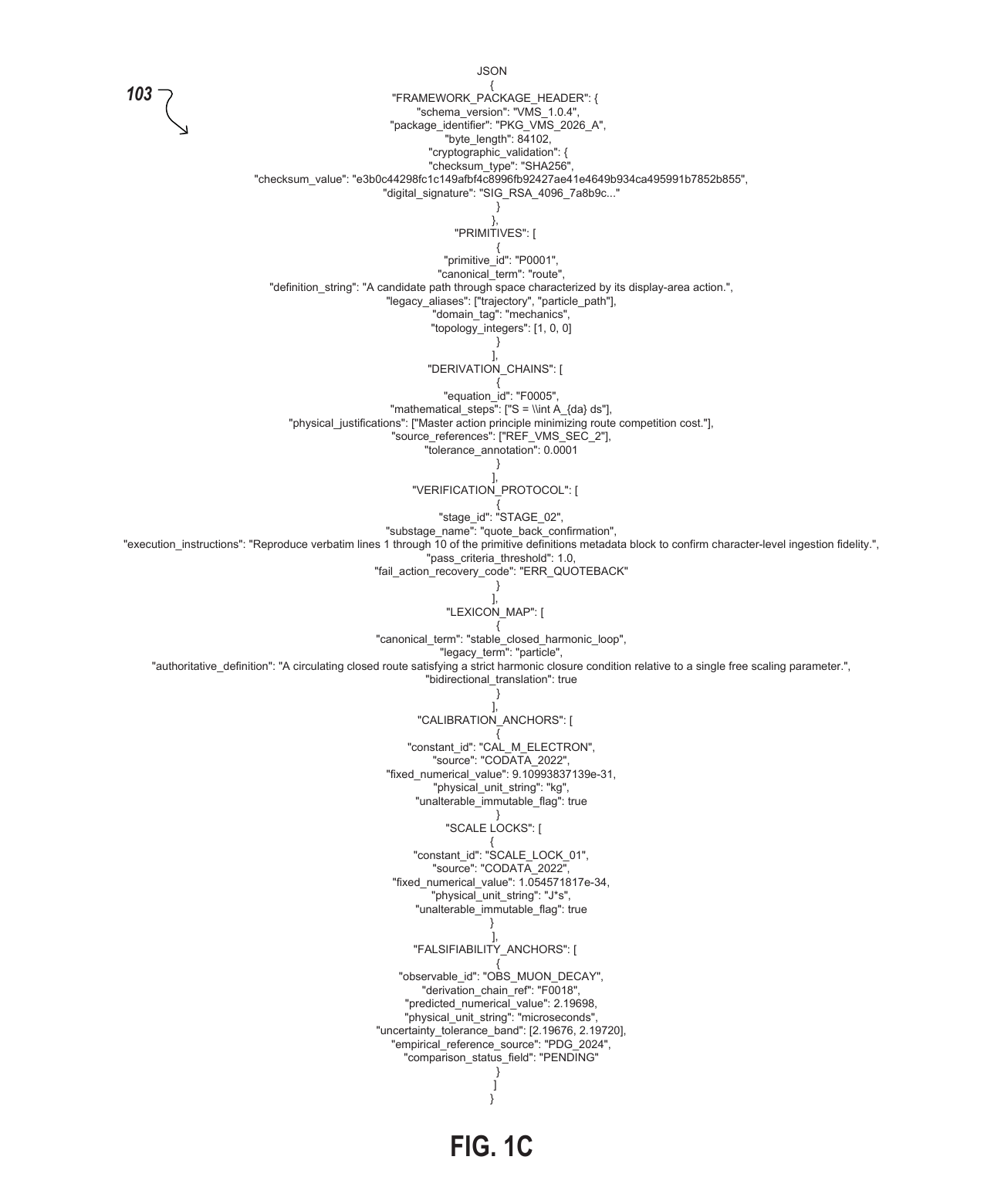
[0148]In some implementations, the packager 144 then processes the entire serialized byte stream to compute and inject a cryptographic signature, e.g., a digital signature generated using a private key, or checksum directly into the file’s validation block. This cryptographic validation data allows the downstream initialization pipeline 101 to verify end-to-end data integrity upon arrival, blocking the ingestion of corrupted or truncated framework records before any AI execution begins. An example compressed package framework in JSON format is shown in FIG. 1C and described below.
[0149]Referring now to FIG. 1B, the initialization pipeline 101 executes a sequential startup and validation sequence to securely ingest the compressed framework package 103, e.g., before enabling any downstream reasoning operations. The initialization pipeline 101 changes internal processing states from an inactive or pending loading phase to an authorized verification configuration. Within this structural arrangement, the loader subsystem 104 decodes the serialized file layout of the compressed framework package 103 and maps out an internal semantic graph representing explicit formulaic and logical dependencies. The verification subsystem 106 then subjects the ingested framework elements to a multi-pass gating structure, checking baseline file integrity, verbatim character-by-character quote-back compliance, lexicon enumeration consistency, and analytical stress performance against registered targets. Throughout this initialization sequence, an ordering controller 108 coordinates state transitions and permanently blocks the execution of incoming data transactions or inference tasks until every validation check returns a successful pass result.
[0150]The runtime execution pipeline 102 provides a continuous, live governance layer that processes active data transactions and token streams to prevent semantic degradation during multi-step scientific reasoning cycles. Operating concurrently after the ordering controller 108 transitions the operational state to active, the runtime execution pipeline 102 manages real-time communication between an AI query or input 122 and an external AI system 126. Incoming prompts are initially screened by a pre-check segment of a domain boundary subsystem 118 to intercept and block out-of-bounds parameters before data delivery to the external AI system 126 occurs. As the external AI system 126 generates response segments, the runtime execution pipeline 102 routes the nascent token streams sequentially through a lexicon mapping subsystem 110 to suppress definition changes, a drift detection subsystem 114 to catch vocabulary drift, a scale enforcement subsystem 112 to freeze fundamental constants, an error propagation subsystem 116 to track uncertainty accumulation, and a post-check segment of the domain boundary subsystem 118 to confirm physical regime compliance. Telemetry alerts and reasoning tracking metrics are continuously published to the message bus and audit log 120, culminating in the release of a physically bounded verified output 124.
[0151]The loader subsystem 104 operates as the entry-point execution block within the initialization pipeline 101 by receiving the compressed framework package 103, e.g., by directly ingesting the compressed framework package 103. Rather than acting as a passive data pass-through, the loader subsystem 104 executes text-parsing routines to read the package file, extract the global header attributes, and systematically map the nested schema elements into volatile system memory. The loader subsystem 104 systematically unpackages and interprets the losslessly compressed structures within the package file, including the PRIMITIVES array, the DERIVATION_CHAINS matrix, the VERIFICATION_PROTOCOL instructions, the LEXICON_MAP lookups, the CALIBRATION_ANCHORS registries, the SCALE_LOCKS, and the FALSIFIABILITY_ANCHORS. During this extraction process, the component translates the compact geometric compression primitives, e.g., topology integer tuples, ratio-first prioritized parameters, and alphanumeric equation identifiers, into active, addressable digital data arrays.
[0152]By processing these structured arrays, the loader subsystem 104 generates an internal semantic graph representing explicit logical, mathematical, and formulaic dependencies across the physical domains of the framework. This outputted internal semantic graph maps every individual primitive term, e.g., VMS route path integrals or closed-loop closure constraints, directly to its respective derivation chains and hardcoded equations via localized memory address pointers. The loader subsystem 104 outputs this highly indexed in-memory graph alongside a specific programmatic control signal designated as FRAMEWORK_LOADED. This output state is sent, e.g., broadcast directly, to the verification subsystem 106 to initiate the automated staged verification gating sequence. This structural conversion ensures that subsequent evaluation layers operate on a fully mapped relational dependency tree rather than fragmented or unparsed text strings, enabling precise downstream validation before the operational state transitions to active.
[0153]The verification subsystem 106 operates as the gatekeeping validation engine within the initialization pipeline 101, executing the multi-pass staged validation sequence defined inside the VERIFICATION_PROTOCOL metadata block. The verification subsystem 106 activates upon receiving the programmatic FRAMEWORK_LOADED control signal from the loader subsystem 104, alongside the compiled in-memory internal semantic graph. Processing these inputs, the verification subsystem 106 sequentially executes multiple discrete, rule-based validation gates to audit the data ingestion fidelity of a target AI model before enabling reasoning operations.
[0154]In a particular example, the verification subsystem 106 can include four validation gates. First, a load-and-integrity check evaluates baseline file completeness and checksum alignments. Second, a verbatim quote-back confirmation forces the AI model to reproduce character-for-character exact text strings from specified metadata rows, failing the entire load verification if even a single character deviation is detected. Third, a lexical enumeration and self-consistency check instructs the AI model to extract the primitive records and verify cross-domain dimensional consistency and loop quantization conditions. Fourth, a stress test directs the AI model to apply the framework equations, e.g., the 31 validated equations from identifier tags F0001 through F0031 in a VMS framework application, to compute target physics predictions for pre-registered holdout observables, comparing the generated outputs against explicit uncertainty tolerance bands to ensure compliance with a strict theoretical baseline error band band where Jc = ±0.01%.
[0155]The verification subsystem 106 functions to construct an unalterable programmatic barrier that isolates the AI model's core inference engine from systematic processing errors, automated hallucinations, and the premature application of unverified statistical weights. As each step of the gating sequence successfully executes, the verification subsystem 106 generates a programmatic control status message designated as SUBSTAGE_COMPLETE, which is routed directly to the ordering controller 108 to drive incremental state transitions. If any validation check fails to achieve its designated pass criteria threshold, the verification subsystem 106 halts progression, suppresses the activation of downstream reasoning layers, and generates a validation failure alert to drop the initialization pipeline 101 into an unverified error state managed by the ordering controller 108. In some implementations, the verification subsystem 106 coordinates directly with physical co-processor hardware registers to perform parallel mathematical range verifications, outputting detailed transaction logs to the message bus and audit log 120 upon successful completion of the entire protocol to signal that the framework is fully established in the active context window.
[0156]The ordering controller 108 operates as a deterministic state machine and execution governance layer coordinating transitions across the initialization pipeline 101 and the runtime execution pipeline 102. The ordering controller 108 processes a sequence of programmatic status messages to manage distinct operational states, e.g., including a “Framework Load Pending” state 702 during active verification, a “Framework Verified” state 704 upon successful validation, a “TMA Mode Active” state 706 during transparent mathematical auditing, an “Error State” 708 triggered by ingestion failures, and a “Recovery” state 710, as described in more detail with reference to FIG. 7. During the startup sequence, the ordering controller 108 acts as a structural validation gateway, receiving individual SUBSTAGE_COMPLETE control signals from the verification subsystem 106 as each progressive validation gate is evaluated. Once the complete multi-pass validation sequence concludes successfully, the ordering controller 108 ingests a final FRAMEWORK_VERIFIED control signal from the verification subsystem 106, which prompts a state transition out of the initial protective lockout phase.
[0157]Upon transitioning to the validated operational regime, the ordering controller 108 generates and broadcasts a specific programmatic control command designated as the ALL_MODULES_ACTIVE signal to the next components within the runtime execution pipeline 102. This ALL_MODULES_ACTIVE output signal acts as the master execution trigger that switches the operational state of the background governance modules from an inactive configuration to a live monitoring configuration. Specifically, this output routes directly to the lexicon mapping subsystem 110, the drift detection subsystem 114, the scale enforcement subsystem 112, the error propagation subsystem 116, and the domain boundary subsystem 118, enabling them to concurrently intercept and process live data transactions between the AI query or input 122 and the external AI system 126. Conversely, if the ordering controller 108 intercepts a validation failure alert during startup or a critical alert message from the error propagation subsystem 116 during live reasoning, it instantly suppresses the ALL_MODULES_ACTIVE signal, drops the execution environment into the Error State 708, and routes explicit state transition log packets to the message bus and audit log 120.
[0158]The message bus and audit log 120 operates as an asynchronous communication backbone, event broker, and persistent recording layer spanning both the initialization pipeline 101 and the runtime execution pipeline 102. The message bus and audit log 120 receives a continuous stream of real-time telemetry data packets, structural transaction logs, constraint violation alerts, and programmatic state-change events broadcast concurrently by the verification subsystem 106, the ordering controller 108, the lexicon mapping subsystem 110, the scale enforcement subsystem 112, the drift detection subsystem 114, the error propagation subsystem 116, and the domain boundary subsystem 118. Processing these incoming data packets, the message bus and audit log 120 executes asynchronous queue management, metadata ingestion, and serialization routines to bind each transaction to a unique, immutable timestamp and context tag. The message bus and audit log 120 acts as the central inter-process communication channel managing error and recovery pathways, enabling the error propagation subsystem 116 to negotiate recovery states or drop commands with the ordering controller 108 over a decoupled event layer. Simultaneously, the message bus and audit log 120 structures and commits these compiled data fields to a non-transitory computer-readable storage matrix, outputting a machine-readable, tamper-resistant audit record.
[0159]The message bus and audit log 120 establishes complete operational visibility, forensic trace-ability, and hardware-software isolation across the reasoning runtime to prevent uncoordinated subsystem failures. By archiving every fine-grained computation step, terminology deviation, scale-locking interception, and boundary enforcement action, the component transforms unstructured AI model interactions into technically bounded and legally defensible verification datasets. The resulting machine-readable audit logs and uncertainty records are outputted as structured text or serialized data streams optimized for independent expert review, automated compliance auditing, and contract verification loops. This architectural encapsulation guarantees that even if the external AI system 126 experiences a catastrophic reasoning failure or statistical drift, the historical trail of systemic exceptions is safely isolated and maintained within the local tracking infrastructure.
[0160]The AI query or input 122 is a digital data packet, natural language prompt sequence, or structured analytical transaction generated by an external software application, user interface, or client node. The AI query or input 122 can represent a specific domain problem, physics calculation request, or multi-step derivation task that an operator intends to execute using the external AI system 126 under the governance of the validated framework. Rather than being routed directly or unrestrictedly to the primary inference engine of the external AI system 126, the AI query or input 122 is held in an ingress memory buffer where it serves as the primary data input for the front-end processing elements of the runtime execution pipeline 102.
[0161]Upon entering the runtime execution pipeline 102, the digital text strings and variables embedded within the AI query or input 122 are intercepted and parsed by the domain boundary subsystem 118 and the lexicon mapping subsystem 110. The domain boundary subsystem 118 extracts physical parameters, environmental conditions, and material properties from the query text and maps them against a multidimensional range matrix to execute a pre-check validation cycle. If this pre-check cycle reveals that the request specifies variables outside the validated physical regimes of the framework, the domain boundary subsystem 118 triggers an out-of-domain rejection, blocking the query from reaching the external AI system 126 and transmitting an automated boundary violation report to the message bus and audit log 120. Simultaneously, if the query passes the domain gate but contains legacy technical terms, the lexicon mapping subsystem 110 executes an input translation step by replacing those legacy expressions with canonical framework primitive identifiers to align the user's intent with the underlying semantic graph. Once fully validated, filtered, and structurally translated, the architecture releases the optimized query string from the ingress memory buffer as a safe, bounded prompt payload to drive the inference cycle of the external AI system 126.
[0162]The domain boundary subsystem 118 can operate as a dual-cycle validation filter and execution guardrail within the runtime execution pipeline 102 to enforce rigid operational constraints on both incoming inquiries and outgoing token streams. The domain boundary subsystem 118 receives its foundational configuration metrics from the domain boundaries component of the compressed framework package 103, which specifies a multidimensional matrix of validated operational regimes, including permissible ranges for physical parameters, material types, environmental conditions, and physical regimes. In a VMS framework deployment, these hardcoded boundaries delineate concrete physical thresholds, e.g., particle rest masses, electromagnetic field strengths, operating temperatures, standard matter density limits, and/or an energy regime restricted exclusively to non-relativistic and relativistic quantum mechanics.
[0163]During the pre-check filtering cycle, the domain boundary subsystem 118 acts on a dedicated ingress memory buffer to intercept the incoming AI query or input 122 before the data transaction is transmitted to the external AI system 126. The hardware processors executing the domain boundary subsystem 118 parse the text strings and numerical variables embedded within the query, mapping them directly against the multidimensional range matrices to evaluate framework compliance. If an out-of-domain condition is detected relative to a designated hard boundary, the domain boundary subsystem 118 enacts a hard boundary rejection that permanently blocks the query payload from reaching the primary inference layers of the external AI system 126. In this event, the domain boundary subsystem 118 generates a structured boundary violation report specifying the exact violated parameter, the valid framework range, and alternative execution actions, routing this report to the message bus and audit log 120 while terminating the active transaction.
[0164]Alternatively, during the post-check filtering cycle, the domain boundary subsystem 118 concurrently monitors the active token streams and numerical predictions generated by the external AI system 126 before they are compiled into the final verified output 124. The post-check filtering cycle evaluates both hard boundaries and soft boundaries to maintain structural framework discipline over multi-step reasoning processes. When a generated prediction or intermediate calculation steps into a speculative regime that violates a designated soft boundary rather than a hard constraint, the domain boundary subsystem 118 permits token generation to proceed but dynamically executes a soft boundary warning injection. This injection seamlessly overlays or appends clear warning annotations directly into the text stream, identifying the output as speculative and detailing the exact nature of the parameter excursion. Furthermore, the domain boundary subsystem 118 operates in continuous cooperation with the error propagation subsystem 116, utilizing hardcoded error propagation formulas to automatically track how uncertainty tolerances grow through sequential mathematical operations. If the accumulated relative variance across successive calculation nodes breaches the framework’s strict theoretical baseline error band, e.g., the Jc = ±0.01%. threshold of the VMS framework, the domain boundary subsystem 118 flags the calculation confidence failure, writes an explicit exception record to the message bus and audit log 120, and appends a prominent confidence degradation notice to the finalized data packet. This dual-gate filtering configuration prevents the external AI system 126 from masking out-of-domain extrapolations behind unannotated token strings, guaranteeing that all released inference sets are technically bounded and physically validated.
[0165]The external AI system 126 includes an AI architecture or model, such as an LLM, a deep neural network, or a machine learning model, that is configured to perform complex, multi-step scientific and technical reasoning across various physical domains. In conventional operational modes, the external AI system 126 scales parameters statistically, introducing a systemic machine limitation where the underlying network gradually degrades over consecutive reasoning layers and substitutes pre-trained baseline statistical biases or associations for the precise definitions and logical constraints of an ingested model. This operational degradation and architectural deficiency directly result in critical processing failures, including uncontrolled semantic drift, automated hallucinations, hallucinated token generations, cross-domain parameter discrepancies, and an inability to maintain strict physical invariants across sequential computation cycles. To remedy these computer-specific errors, the execution runtime of the external AI system is bounded by a deterministic hardware-software hybrid governance layer established by the initialization pipeline 101 and the runtime execution pipeline 102.
[0166]The external AI system interacts dynamically with the components of FIG. 1A and FIG. 1B by receiving structured, validated data payloads and returning raw execution outputs to the background monitoring layers. Specifically, from the initialization pipeline 101, the external AI system receives the losslessly encoded elements of the compressed framework package 103 directly into its active context memory window to alter the mathematical boundaries within which token execution occurs and optimize token utilization. It also receives programmatic instruction strings and validation commands from the verification subsystem 106 to execute sequential validation checks, such as file integrity audits, verbatim character-by-character quote-back confirmations, and holdout stress tests, before its primary reasoning operations are unlocked by the ordering controller 108. During live reasoning operations within the runtime execution pipeline 102, the external AI system 126 receives an optimized, filtered, and translated user query payload that has been pre-validated for regime compliance and terminology alignment. In response, the external AI system 126 provides nascent output token streams, intermediate mathematical derivation steps, physical justifications, dimensional checks, and numerical predictions back to the runtime execution pipeline 102. Rather than being released directly to an operator, these outputs are delivered sequentially to concurrent background governance components, including the lexicon mapping subsystem 110, the scale enforcement subsystem 112, the drift detection subsystem 114, the error propagation subsystem 116, and the domain boundary subsystem 118, which continuously analyze, filter, correct, and bound the data stream to generate the finalized verified output 124.
[0167]The lexicon mapping subsystem 110 operates as a real-time terminology conversion and contextual enforcement engine within the runtime execution pipeline 102. The lexicon mapping subsystem 110 receives two distinct operational data streams: first, the serialized LEXICON_MAP array extracted from the compressed framework package 103 by the loader subsystem 104 during initialization; and second, active data transactions consisting of either user text strings from the AI query or input 122 or nascent output token streams generated live by the external AI system 126. Powered by the physical hardware processors of the architecture, the lexicon mapping subsystem 110 evaluates the bidirectional translation boolean flags embedded within each registry record to determine whether an intercepted term operates symmetrically or asymmetrically across the vocabulary frameworks. For input operations, the lexicon mapping subsystem 110 intercepts the AI query or input 122 and parses incoming legacy scientific terms, executing string-substitution routines that swap those legacy terms with canonical framework primitive identifiers to directly align user intent with the verified underlying semantic graph. For output operations, as the external AI system 126 generates response strings, the lexicon mapping subsystem 110 scans the live tokens to perform reverse-substitutions, converting complex framework primitives back into user-friendly legacy expressions to facilitate clear, human-readable expert review without sacrificing the underlying mathematical and semantic precision of the framework.
[0168]The lexicon mapping subsystem 110 creates a persistent, unalterable semantic anchor that counteracts the inherent tendency of statistical language models to gradually substitute pre-trained baseline statistical biases for precise framework rules over prolonged text generations. This operational degradation, if unmitigated, introduces systematic failures including automated hallucinations and cumulative semantic drift that corrupt multi-step scientific derivations. The lexicon mapping subsystem 110 continuously counters these computer-specific processing deficiencies by outputting a normalized, term-stabilized token stream that is routed downstream to the drift detection subsystem 114 and the scale enforcement subsystem 112. If an incoming or outgoing term lacks identical, one-to-one conceptual alignment or is flagged as an asymmetrical mapping due to its boolean flag evaluating as false, the lexicon mapping subsystem 110 enforces strict single-direction translation constraints to prevent improper reverse-substitutions. Every terminology modification, substitution event, and translation exception is compiled into a telemetry data packet and routed directly to the message bus and audit log 120, providing an immutable audit trail that tracks terminology alignment from raw query ingestion to the finalized verified output 124.
[0169]The drift detection subsystem 114 operates as a real-time semantic monitoring, token analysis, and statistical validation engine within the runtime execution pipeline 102. The drift detection subsystem 114 receives the term-stabilized token stream from the lexicon mapping subsystem 110 alongside the authoritative LEXICON_MAP configuration array and registered definition matrices compiled from the compressed framework package 103. Hardware processors executing the drift detection subsystem 114 run an analytical tokenization and comparison workflow that parses output text structures and executes continuous natural language comparisons against the registered definitions. Specifically, the component implements lexicon locking by maintaining a usage frequency table that tracks how often each primitive is used across the output token streams generated by the external AI system 126. For every intercepted term, the subsystem executes a lookup procedure to evaluate the active usage context against a configurable similarity threshold. When the usage context of a term deviates from its registered definition by more than this threshold, the drift detection subsystem 114 triggers an enforcement trigger that flags the deviation, generates a telemetry drift flag, and logs a detailed transaction entry to the message bus and audit log 120.
[0170]The drift detection subsystem 114 is configured to detect and suppress cumulative semantic drift, which manifests as a gradual deviation in the meaning or application of foundational terms over a plurality of sequential reasoning steps. AI models exhibit an inherent machine flaw where long text generations cause them to gradually substitute pre-trained baseline statistical biases or associations for precise framework definitions, leading to automated hallucinations, reasoning errors, and uncalibrated expansions. The drift detection subsystem 114 directly counteracts this computer-specific degradation by executing trend analysis to catch slow, incremental divergence patterns before they corrupt complex scientific derivations. In addition to logging deviations, the outputted drift telemetry from the drift detection subsystem 114 is routed concurrently to the ordering controller 108, enabling the architecture to execute automated recovery loops, switch states, or optionally halt reasoning pending human review if an uncontrolled semantic shift occurs. This continuous token-level audit ensures that the final verified output 124 remains perfectly aligned with the rigid conceptual boundaries of the underlying knowledge base.
[0171]The scale enforcement subsystem 112 operates as a real-time mathematical monitoring, hardware-level constraint enforcement, and transaction interception engine within the runtime execution pipeline 102. The scale enforcement subsystem 112 receives two primary data inputs: first, the term-stabilized token stream and active mathematical expressions generated live by the external AI system 126 during its reasoning cycles; and second, the hardcoded SCALE_LOCKS block containing the locked-constants register configuration initialized from the compressed framework package 103. Upon package ingestion during the initialization phase, the hardware processors executing the scale enforcement subsystem 112 identify and load the locked constants directly into physical hardware registers to prepare for single-cycle comparator evaluations. During live reasoning operations, the scale enforcement subsystem 112 intercepts all mathematical operations, parameter assignments, numeric evaluations, and contextual token structures performed by the external AI system 126. The scale enforcement subsystem 112 monitors these data streams for specific keywords, variable flags, or numeric values that suggest an attempt to modify, re-tune, adjust, substitute, or add extraneous variables to a fundamental constant. In a VMS framework application, the scale enforcement subsystem 112 continuously guards the primary action scale parameter, which is locked to an exact unalterable value where S ℏ 1.054571817 10 𝐽 ∙ 𝑠. When an attempted modification or assignment violation is detected by the physical registers, the scale enforcement subsystem 112 rejects the operation, suppresses the unauthorized token generation, forces the retention of the original locked value, and proactively injects an automated system explanation detailing why the constant is locked into the active processing loop of the external AI system 126.
[0172]The scale enforcement subsystem 112 is to configured protect the downstream reasoning environment from parameter drift, floating variables, or arbitrary empirical fine-tuning that masks analytical failures. AI models exhibit an architectural flaw where they dynamically drift, float, modify, or add extraneous constants during deep calculations to forcefully mask intermediate mathematical errors or hide discrepancies between independent physical domains. The scale enforcement subsystem 112 directly counteracts these computer-specific processing deficiencies by establishing hardwired numerical boundary restrictions before any downstream inference calculations are released. The scale enforcement subsystem 112 outputs a validated, scale-stabilized mathematical data stream to subsequent processing blocks, ensuring that the external AI system 126 does not introduce additional unauthorized free parameters or manipulate invariant physical constants to achieve false mathematical convergence. Every interception event, constant assignment violation, and system intervention executed by the scale enforcement subsystem 112 is compiled into a timestamped telemetry log packet and routed directly to the message bus and audit log 120, enabling the ordering controller 108 to immediately trigger an automated state change or dump the active context window into an unverified error state if systemic integrity is breached.
[0173]The error propagation subsystem 116 operates as a real-time mathematical auditing, uncertainty tracking, and risk mitigation engine within the runtime execution pipeline 102. The error propagation subsystem 116 receives the scale-stabilized mathematical data stream and active derivation steps generated live by the external AI system 126, alongside the hardcoded error propagation formulas, input tolerance ranges, and operation-level error propagation rules initialized from the compressed framework package 103. The hardware processors executing the error propagation subsystem 116 implement a strict error propagation discipline to manage mathematical uncertainty. As the external AI system 126 processes calculations across sequential derivation chains or computation nodes, the error propagation subsystem 116 explicitly tracks how input tolerances grow through each mathematical operation based on the hardcoded arithmetic rules. The subsystem continuously computes an updated cumulative output tolerance or compiled relative variance for the active derivation chain and compares this computed variance against the framework's registered baseline closure tolerance threshold. In a VMS framework deployment, this threshold is hardcoded as a strict theoretical closure tolerance where Jc = ±0.01%.
[0174]The error propagation subsystem 116 is configured to enforce mathematical discipline and eliminate hidden variance cascading during deep, multi-step scientific reasoning. AI models exhibit an inherent machine flaw where minor rounding differences, symbolic approximation deviations, or cumulative reasoning errors accumulate unchecked across consecutive computation layers, causing catastrophic arithmetic drift or false convergence while appearing textually coherent. The error propagation subsystem 116 directly addresses these computer-specific processing deficiencies by converting abstract token generation into a machine-auditable, variance-bounded execution process. If the compiled relative variance remains within the allowed threshold, the error propagation subsystem 116 outputs a verified, uncertainty-bounded mathematical dataset downstream toward the domain boundary subsystem 118, while simultaneously writing a machine-readable uncertainty record to the message bus and audit log 120. Conversely, if the accumulated variance breaches the Jc = ±0.01% threshold, the error propagation subsystem 116 manages error and recovery pathways by intercepting the transaction, suppressing the unverified output, and issuing a programmatic critical alert message to the ordering controller 108 via the message bus to dump the active context window or trigger an automated state change.
[0175]The domain boundary subsystem 118 operates as a real-time, dual-cycle validation filter and execution guardrail within the runtime execution pipeline 102. The domain boundary subsystem 118 receives its foundational technical parameters from the domain configuration rules embedded within the compressed framework package 103, which specify a multidimensional matrix of validated operational regimes comprising permissible ranges for physical parameters, material types, physical regimes, and environmental conditions. In a VMS framework application, these hardcoded boundaries delineate concrete physical thresholds, such as particle rest masses, electromagnetic field strengths, operating temperatures, standard matter density limits, and/or an energy regime restricted exclusively to non-relativistic and relativistic quantum mechanics. The domain boundary subsystem 118 concurrently monitors two distinct live data transactions: an incoming inquiry string from the AI query or input 122 held in an ingress memory buffer, and nascent output token streams or numerical predictions generated live by the external AI system 126.
[0176]To process these inputs, the domain boundary subsystem 118 executes distinct pre-check and post-check filtering cycles to evaluate data transactions against the multidimensional range matrix. During the pre-check filtering cycle, the component intercepts the AI query or input 122 before the data payload reaches the external AI system 126, parsing embedded variables to ensure regime compliance. If a parameter violates a designated hard boundary, the domain boundary subsystem 118 executes a hard boundary rejection that blocks prompt transmission, terminates the active transaction, and outputs a structured boundary violation report to the message bus and audit log 120 specifying the violated parameter, the valid framework range, and alternative execution paths. During the post-check filtering cycle, the component reviews active token generations and intermediate calculations before they are compiled into the final verified output 124. If a generated calculation violates a designated soft boundary, the domain boundary subsystem 118 executes a soft boundary warning injection, dynamically overlaying or appending prominent warning annotations to flag the output as speculative. Furthermore, the domain boundary subsystem 118 mathematically cooperates with the error propagation subsystem 116 using hardcoded error propagation formulas to track uncertainty accumulation. If the relative variance across successive calculation nodes breaches the framework’s strict baseline error band, such as the Jc = ±0.01% threshold, the domain boundary subsystem 118 flags the confidence failure, writes a telemetry exception record to the message bus and audit log 120, and appends a confidence degradation notice to prevent hidden out-of-domain extrapolations.
[0177]The verified output 124 is the finalized, computationally stabilized, and physically validated data product generated and released by the runtime execution pipeline 102. The verified output 124 is constructed from the raw, nascent token streams, mathematical progressions, and text generations outputted live by the external AI system 126. Rather than allowing the unchecked statistical generations of the external AI system 126 to be delivered directly to a user interface or downstream application, the runtime execution pipeline 102 passes the raw data sequentially through a multi-layered background governance architecture comprising the lexicon mapping subsystem 110, the scale enforcement subsystem 112, the drift detection subsystem 114, the error propagation subsystem 116, and the domain boundary subsystem 118. This rigorous filtering and adjustment sequence ensures that any semantic distortions, constant modifications, vocabulary deviations, or out-of-domain variables are caught and corrected or annotated before the final package compilation occurs. The resulting verified output 124 is structurally represented as a machine-readable data packet, a formatted document, or an itemized inference set conforming to a deterministic schema. This digital output file explicitly incorporates the normalized token strings, the validated derivation metrics, and any embedded structural annotations, e.g., soft boundary warning text or confidence degradation notices injected by the domain boundary subsystem 118 if the calculation entered a speculative regime or breached a tolerance threshold.
[0178]The verified output 124 can provide an engineering-grade, mathematically disciplined, and legally defensible derivation or reasoning set that is completely free from the systematic machine limitations of conventional neural networks. In conventional architectures, long text generations result in cumulative processing failures, including uncontrolled semantic drift and automated hallucinations, wherein the network substitutes statistical guesses for precise framework invariants. The verified output 124 directly cures these computer-specific deficiencies by delivering an unalterable, bounded, and machine-auditable result that strictly adheres to the core parameters and mathematical closures of the compressed framework package 103. In some implementations, when the architecture operates in a transparent math-audit mode, the verified output 124 is formatted to expose all intermediate derivation steps, physical justifications, substitution sources, and dimensional checks, saving them to an immutable, structured audit record within non-transitory computer-readable storage. This comprehensive structural encapsulation ensures that the finalized output can be utilized reliably within highly sensitive technical domains, including materials science, superconductivity, and quantum metrology, without risking downstream system failures or analytical discrepancies.
[0179]FIG. 1C shows a portion of an example compressed framework package 103 in JSON format. The machine-readable compressed framework package 103 is organized according to a rigid, hierarchical data schema that ensures deterministic parsing and runtime validation by downstream components. As represented in the data schema, the compressed framework package 103 incorporates a global header block designated as FRAMEWORK_PACKAGE_HEADER, which contains specific structural metadata attributes comprising a schema version identifier, a unique package identifier, a file byte length indicator, and a cryptographic validation block. The cryptographic validation block stores a checksum type definition, a pre-computed byte-stream checksum value, and a digital signature generated via a private encryption key. This metadata configuration enables the initialization pipeline 101 to verify file completeness and reject corrupted, modified, or truncated data inputs before any downstream AI model operations are permitted to change states.
[0180]The data schema partitions the structural components of the ingested knowledge base into dedicated typed data arrays to optimize context memory footprint and enforce mathematical constraints. The PRIMITIVES array contains a plurality of typed records for atomic foundational units, wherein each entry includes a unique primitive identifier string, a canonical term name, an authoritative definition string, an array of legacy terminology aliases, a physical domain tag, and an array of topology integers recording winding numbers, linking numbers, and torsion invariants. The DERIVATION_CHAINS array specifies a complete relational dependency graph of validated equations, wherein each entry maps a unique alphanumeric equation identifier to a sequence of mathematical step strings, physical justification statements, source documentation references, and precise tolerance annotations to enable step-by-step mathematical derivation auditing. To govern the initialization security gates, the VERIFICATION_PROTOCOL block structures the rule-based execution paths for validating ingestion fidelity, populating each validation stage record with an explicit stage identifier, a descriptive substage name, detailed execution instructions, a strict pass criteria threshold, and an automated fail action recovery code.
[0181]To manage continuous context monitoring, the data schema further includes a LEXICON_MAP array, a CALIBRATION_ANCHORS block, a SCALE_LOCKS block, and a FALSIFIABILITY_ANCHORS block embedded within the unified file layout. The LEXICON_MAP array contains typed dictionary records that pair canonical framework concepts with legacy physics equivalents, where each entry enforces a canonical term field, a legacy term field, an authoritative definition string, and a bidirectional translation boolean flag to drive real-time terminology comparison. The CALIBRATION_ANCHORS block stores fixed empirical measurements and constraints marked for absolute stability, populating each record with a unique constant identifier, an empirical source citation, a fixed numerical value, a physical unit string, and an unalterable immutable boolean flag that hardcodes foundational parameters against dynamic tuning. The SCALE_LOCKS block stores single-parameter scale locks that hardcode foundational scaling constants at their canonical values, populating each record with a unique constant identifier, an empirical source citation, a fixed numerical value, a physical unit string, and an unalterable immutable boolean flag that prevents any modification of the scale constant during downstream AI reasoning. Finally, the FALSIFIABILITY_ANCHORS block establishes the holdout registry configuration for stress testing, wherein each record links a unique observable identifier to a parent derivation chain reference, a predicted numerical value, a physical unit string, a multidimensional uncertainty tolerance band, a peer-reviewed empirical reference source, and a dynamic comparison status field initialized to a pending state.