12. Processes
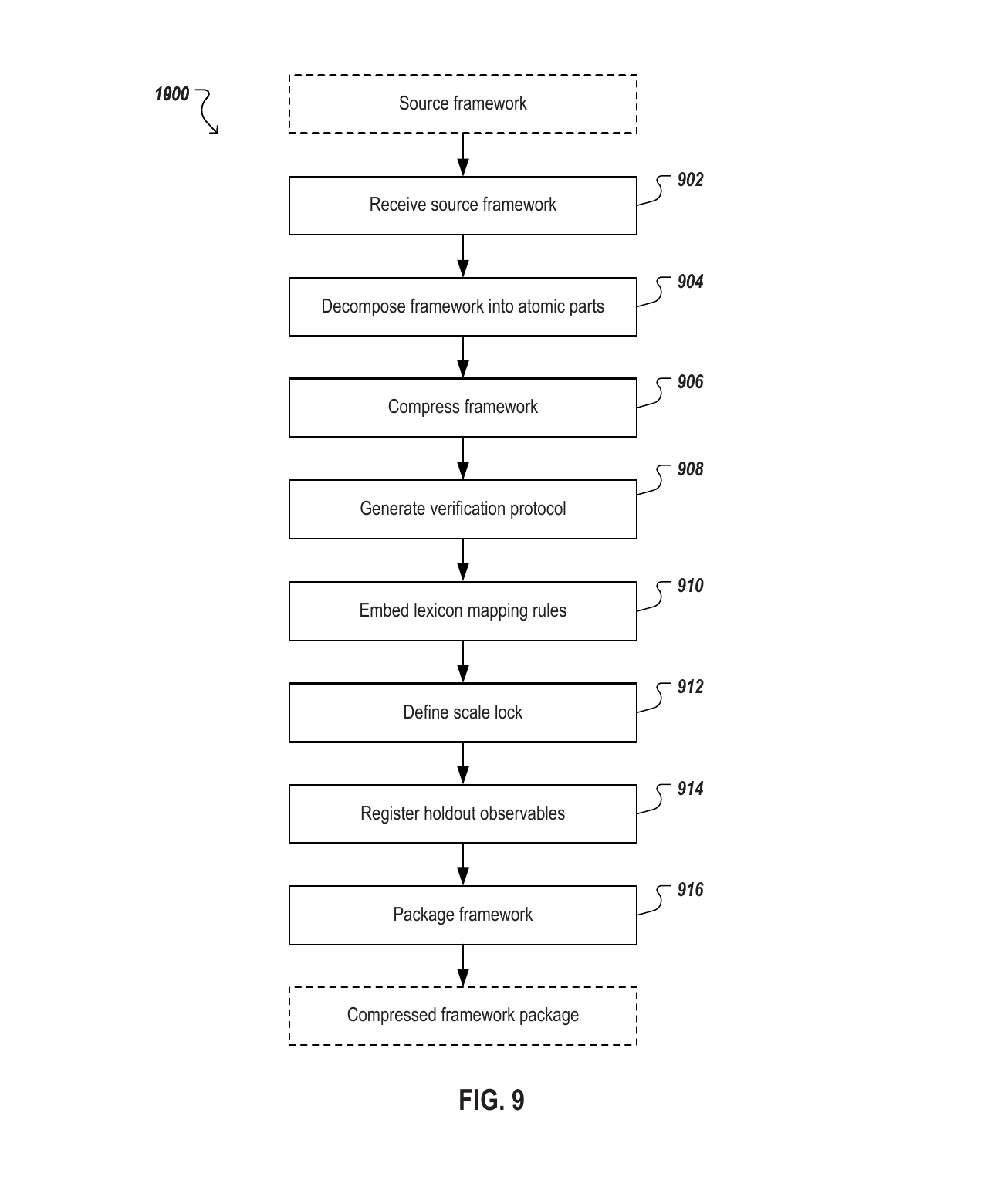
[0271]FIG. 9 is a flowchart illustrating an example process 900 for converting a source framework into a packaged compressed framework representation. The process 900 can be performed by a system, e.g., the system of FIGs. 1A and 1B or the system 800 of FIG. 8. The operations of the process 900 can also be implemented as instructions stored on a computer readable medium, which can be non-transitory. Execution of the instructions, by one or more data processing apparatus, causes the one or more data processing apparatus to perform operations of the process 900. For brevity, the process 900 is described in terms of being performed by a system.
[0272]The process 900 illustrated in FIG. 9 maps out the logical sequence of operations executed to transform a complex domain-specific scientific knowledge base into a secure, machine-readable asset optimized for neural reasoning networks. This workflow systematically translates abstract scientific principles, mathematical formulations, and empirical metrics into bounded operational blocks within an integrated pipeline framework.
[0273]The system executes front-end data acquisition and ingestion procedures to ingest an uncompressed raw source framework 128 (902). This operation can be performed by the receiver 130 within the preparation pipeline 100. For example, the receiver 130 can initiate file-level ingestion by reading the framework file stream, evaluating format boundary validations, and executing data structure parsing loops on multiple textual definitions, mathematical expressions, calibration variables, and contextual metadata to compile an uncompressed, unstructured text array within local volatile memory.
[0274]The receiver 130 performs preliminary syntax checks to confirm that the input format matches expected data structures, e.g., expected JSON or XML data structures, before data routing occurs, thereby preventing file-level errors during initialization. In specific implementations, such as processing a VMS framework, the receiver 130 manages the text ingestion of multiple validated equations, primitives, and pre-calculated anchors to ensure complete file readability within memory before downstream processing begins.
[0275]The system performs algorithmic segregation on the uncompressed text array to structurally isolate global framework semantics into distinct data subdivisions (904). This operation can be performed by the decomposer 132 within the preparation pipeline 100. The decomposer 132 splits the framework contents into separate, typed data structures consisting of an array of primitive definitions, an array of derivation chains with mathematical justifications, a registry of calibration anchors with original measurement sources, and a registry of falsifiability anchors with expected range bounds. This structural transformation converts sprawling narrative explanations and raw variables into clean operational data blocks, ensuring deterministic machine parsing by downstream software and hardware loops.
[0276]The decomposer 132 distributes these segregated arrays in parallel across a multi-channel processing architecture to drive subsequent configuration components. The decomposer 132 extracts primitive definitions including unique identifiers, definition strings, legacy terminology aliases, and topology integers tracking winding numbers, linking numbers, or torsion invariants. Concurrently, the decomposer 132 parses individual step records within derivation chains that document specified mathematical operations, physical justifications, and unique equation identifiers. The decomposer 132 further isolates fixed calibration constraints and test targets inside the falsifiability arrays to build a standardized catalog for downstream machine evaluation.
[0277]The system applies geometric compression primitives to the segregated data blocks to losslessly minimize data size while preserving complete semantic fidelity (906). This operation can be performed by the compressor 134 within the preparation pipeline 100, and the resulting compressed structures can be subsequently managed during runtime execution by the physical hardware co-processor 802 or the drift detection unit 814. The compressor 134 executes algorithmic compression routines to losslessly reduce the active memory footprint of the database, which functions to optimize token utilization within the active context memory window of an AI model.
[0278]The compressor 134 utilizes multiple compression methods including topology integers to encode complex spatial relationships as compact numerical arrays, ratio-first encoding to prioritize dimensionless ratios over absolute dimensional scales, and tagged equations to assign unique alphanumeric identifiers to individual derivation steps. Additionally, the compressor 134 implements elimination of redundant axioms to prune logically equivalent mathematical expressions from the active framework file and embeds bidirectional lexicon mapping to create an interactive lookup registry that bridges divergent terminology vocabularies. These integrated routines reduce the physical file size of the knowledge base by at least 40 percent compared to an uncompressed representation of the same framework, minimizing token consumer saturation during complex multiphysics derivations.
[0279]The system constructs an independent, machine-readable validation configuration mapping out a multi-pass staged validation sequence to audit ingestion fidelity (908). This operation can be performed by the verification protocol generator 136 within the preparation pipeline 100, and the generated instructions can be subsequently executed and audited by the verification subsystem 106 or the hardware-based verification pipeline 808. The verification protocol generator 136 transforms the raw atomic units into structured validation rules, populating each validation substage record with an explicit stage identifier, a descriptive name, execution instructions, pass criteria thresholds, and automated fail action recovery codes.
[0280]The verification protocol generator 136 maps the ingested parameters across a sequence of multiple distinct validation gates including a load-and-integrity check to evaluate baseline file completeness, a quote-back confirmation to verify character-level text reproduction, a lexical enumeration check to test dimensional consistency, and a final stress test to compute target physics predictions within specific theoretical tolerance bands. This protective gateway targets specific machine failures, including the tendency of language models to falsely claim complete file ingestion when they have only processed partial text strings or substituted pre-trained statistical weights for precise framework constraints.
[0281]The system embeds specialized terminology conversion rules to maintain semantic consistency and manage bidirectional translations across disparate vocabulary frameworks (910). This operation can be performed by the lexicon mapping embedder 138 within the preparation pipeline 100, and the embedded rules can be subsequently utilized during active reasoning by the lexicon mapping subsystem 110 or the lexicon lookup unit 806. The lexicon mapping embedder 138 outputs lexicon mapping rules formatted as an independent, machine-readable array containing typed records organized within a structured database translation table. Each individual record is populated with a canonical framework term field, a legacy term field, an authoritative definition string, and a bidirectional translation boolean flag.
[0282]The lexicon mapping embedder 138 pairs novel framework concepts with conventional science terminology to establish a rigid dictionary, such as binding the legacy term particle to a stable closed harmonic loop primitive and mapping the legacy term force to a gradient of a missing-space profile primitive. These embedded mapping rules provide a persistent semantic anchor that counteracts the inherent tendency of statistical language models to gradually substitute pre-trained baseline statistical biases or associations for precise framework rules over prolonged text generations. This configuration establishes the authoritative lookup matrix used by downstream validation filters to parse and stabilize terminology usage in real time.
[0283]The system establishes mathematical immutability designations within the calibration datasets to enforce real-time constant validation and block dynamic variable tuning (912). This operation is performed by the scale lock definer 140 within the preparation pipeline 100, and the immutable designations can be subsequently enforced during model execution by the scale enforcement subsystem 112 or the hardware-based scale lock comparator 804. The scale lock definer 140 scans the incoming calibration data to identify fundamental constants marked for absolute stability, populating specific typed fields including a unique constant identifier, a fixed numerical value, a physical unit string, and an unalterable immutable boolean flag.
[0284]The scale lock definer 140 isolates fundamental parameters, such as hardcoding a primary action scale parameter to an exact value, e.g., S₀ = ℏ, to ensure that the parameter cannot be re-tuned, adjusted, or modified in any reasoning context. This structural configuration protects the downstream reasoning environment from parameter drift, floating variables, or arbitrary fine-tuning. AI models exhibit a common machine flaw where they float, modify, or add extraneous constants during deep calculations to forcefully mask mathematical errors or cover up intermediate discrepancies. The scale lock definer 140 counteracts these computer-specific processing errors by locking the foundational parameters before any token execution commences, allowing downstream hardware registers to perform single-cycle comparator evaluations.
[0285]The system catalogs empirical verification metrics within a structured holdout registry configuration to ground theoretical outcomes in experimental reality (914). This operation can be performed by the holdout observable registrar 142 within the preparation pipeline 100, and the registered verification metrics can be subsequently leveraged during validation by the verification subsystem 106 or the verification pipeline 808. The holdout observable registrar 142 processes data within the falsifiability anchors array to connect pre-calculated theoretical outcomes with experimental testing criteria, populating specific fields including a unique observable identifier, a predicted numerical value with units, an uncertainty tolerance band, an empirical reference value, and a dynamic comparison status field.
[0286]The holdout observable registrar 142 pairs each holdout observable record with direct cross-reference pointers pointing back to unique equation identifiers to map explicit calculation provenance. This registry protects the downstream reasoning environment from uncalibrated extrapolations and speculative conclusions, counteracting the machine flaw where neural models fail to distinguish well-calibrated framework constraints from abstract, hallucinated extensions over long reasoning steps. The outputted holdout observable registry is integrated directly into the final package file layout to facilitate automated stress testing upon package ingestion without requiring external host database connections.
[0287]The system hierarchically structures, cross-references, and encodes each processed data block to compile a single machine-readable data file conforming to a rigid validation schema (916). This operation can be performed by the packager 144 within the preparation pipeline 100, and the finished package document can be subsequently delivered to the loader subsystem 104. The packager 144 accepts the independent outputs generated by the compression, verification, terminology mapping, scale locking, and holdout registration components, mapping them into dedicated schema arrays within a unified serialized document structure.
[0288]The packager 144 serializes the data file into a structured text document, e.g., a JSON or an XML data file, which maps explicit field keys, typed values, and array bounds to support automated downstream parsing loops. To finalize the framework package for transmission and ingestion, the packager 144 appends a global header block containing structural metadata and can also process the entire serialized byte stream to compute and inject a cryptographic signature or checksum directly into the file's validation block. This cryptographic validation data yields the finalized compressed framework package 103 as a completely self-sufficient unit of delivery, allowing downstream initialization pipelines to verify data integrity upon arrival and block the ingestion of corrupted or truncated records before any token execution begins.
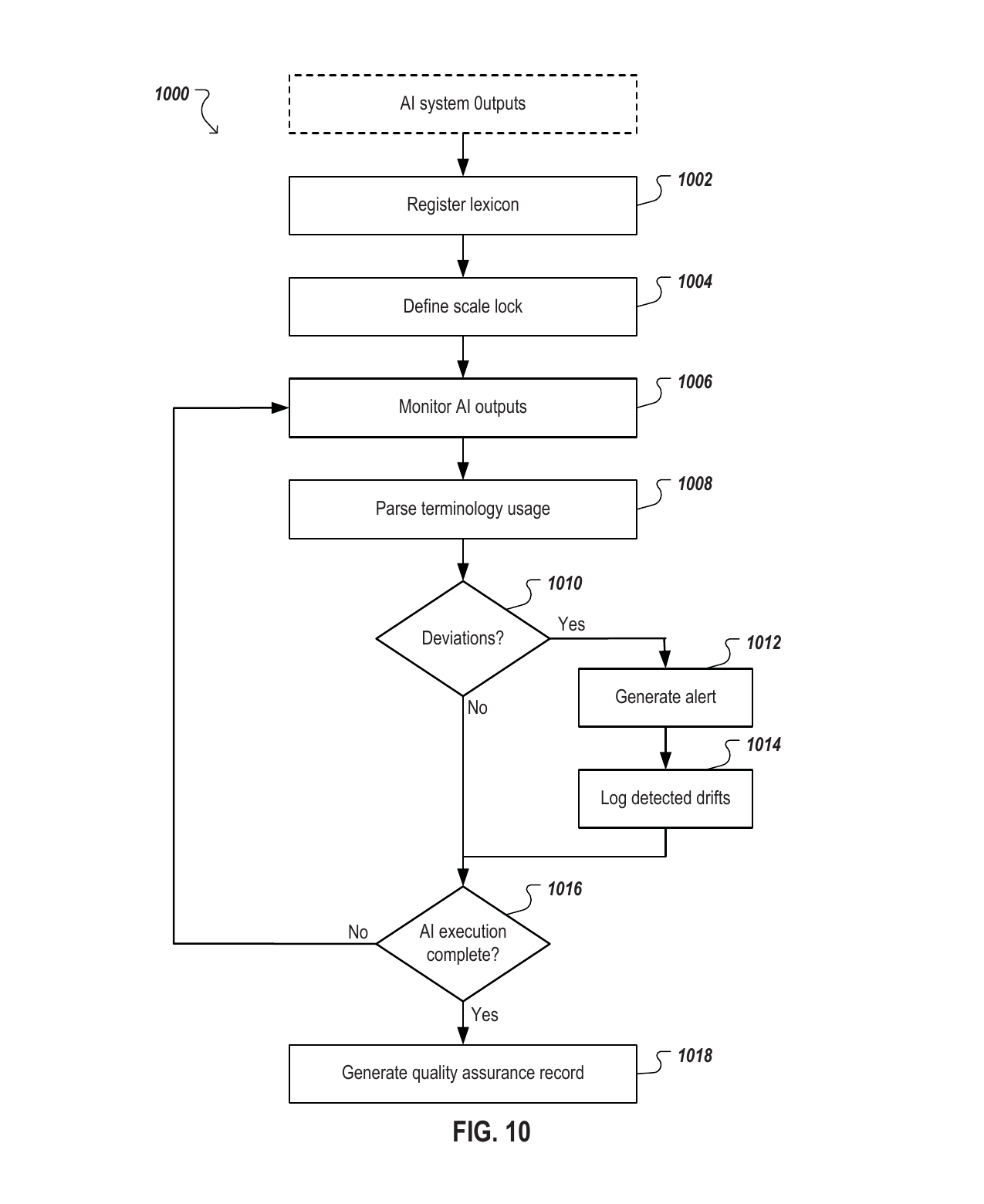
[0289]FIG. 10 is a flowchart illustrating an example process 1000 for real-time monitoring and logging of continuous term usage drift. The process 1000 can be performed by a system that includes one or more computers, e.g., the system of FIGs. 1A and 1B or the system 800 of FIG. 8. The operations of the process 1000 can also be implemented as instructions stored on a computer readable medium, which can be non-transitory. Execution of the instructions, by one or more data processing apparatus, causes the one or more data processing apparatus to perform operations of the process 1000. For brevity, the process 1000 is described in terms of being performed by a system.
[0290]The process 1000 illustrated in FIG. 10 maps out the continuous monitoring workflow executed to detect, track, and suppress terminology deviations and semantic drift in real time during model execution. This sequence of operations establishes a live runtime governance layer that forces an AI model to maintain conceptual alignment with an ingested technical knowledge base across sequential calculation cycles.
[0291]The system registers a lexicon (1002). For example, the system can execute baseline registry initialization procedures to establish an authoritative linguistic standard by registering a lexicon of domain primitives, derived terms, and aliases together with canonical definitions. This operation can be performed by the lexicon mapping embedder 138 within the preparation pipeline 100 during asset packaging, or it can be executed during initialization when the loader subsystem 104 populates the registered lexicon. This initialization process constructs an in-memory database lookup table or an associative array that houses an ordered list of registered terms, abbreviations, canonical definitions, and cross-domain tags.
[0292]In some implementations, e.g., a VMS framework application, this operation maps novel framework primitives directly to conventional science equivalents, creating explicit associative pairs that link legacy expressions like particle, force, or charge to stable closed harmonic loops, gradients of missing-space profiles, or orientation-gated effects. This indexed directory establishes the baseline ground-truth benchmark against which all active word selections are subsequently evaluated by downstream validation filters.
[0293]The system defines one or more scale locks (1004). For example, the system can establish numerical invariance restrictions within a locked-constants register by defining at least one single-parameter scale lock designating a foundational parameter as immutable. This operation can be performed by the scale lock definer 140 within the preparation pipeline 100, and the unalterable scale criteria are subsequently loaded into the physical registers of the scale enforcement subsystem 112 or the hardware-based scale lock comparator 804. This operation identifies fundamental constants marked for absolute stability and populates specific typed fields including a unique constant identifier, a fixed numerical value, physical unit strings, and an unalterable immutable boolean flag.
[0294]By defining, e.g., hardwiring, the primary action scale parameter to an exact value, such as S₀ = ℏ, this operation prevents the model from altering foundational constants over long text generations. This restriction addresses the machine flaw where neural networks float, modify, or add extraneous variables during deep calculations to forcefully mask mathematical errors or hide intermediate discrepancies between independent physical domains. The scale lock(s) ensure that any assignment modification attempt is instantly intercepted and rejected, forcing the retention of the original locked value within the execution loop.
[0295]The system monitors AI outputs (1006). For example, the system can intercept nascent text generation segments and analytical sequences in real-time during the execution of an AI model by monitoring outputs and reasoning steps of an AI execution environment. This operation can be performed by the drift detection subsystem 114, the hardware-driven drift detection unit 814, or the post-check filtering cycles of the domain boundary subsystem 118. As the external AI model or external AI system processes a machine learning task, e.g., a multi-step derivation task, the generated output token stream is continuously captured and routed through various monitoring filters before being compiled or released to an external user interface.
[0296]This real-time interception operates as a continuous, live governance layer that treats nascent tokens as an active transaction stream. Rather than acting as a post-hoc text script, this monitoring step reviews the active token output window at each generation step. This background filtration ensures that any semantic distortions, constant mutations, or out-of-domain variables are caught before they can accumulate and corrupt the final inference dataset.
[0297]The system parses terminology usage (1008). For example, the system can segment the captured text structures into discrete, machine-addressable word sub-units and isolates the situational syntactic environment by parsing terminology usage in the outputs of the architecture. This operation can be performed by the tokenizer 302 and the context extractor 304 inside the drift detection subsystem 114, or it can be executed within the content-addressable memory of the lexicon lookup unit 806. The system runs an analytical tokenization workflow that segments output text structures into word forms, symbols, alphanumeric hashes, and linguistic units while stripping formatting anomalies and isolating individual primitive identifiers.
[0298]Once the text is tokenized, the system maintains a localized lookahead and lookback buffer to capture a precise context window preceding and succeeding each intercepted target primitive. This operation parses adjacent adjectives, dependent mathematical operations, conditional operators, and domain-specific variables to compile an active usage context vector for the term. This context vector represents the localized statistical and logical environment in which the model has applied the framework terminology during that specific generation cycle.
[0299]The system determines whether there are any deviations (1010). To achieve continuous verification, the semantic comparator 306 or the hardware-driven drift detection unit 814 runs an analytical comparison workflow to check whether the active usage context of an intercepted primitive term aligns with its canonical definition. This monitoring operation can be executed by querying the registered lexicon 312 to fetch the corresponding canonical definition string and authoritative constraints for the designated term. The system can then evaluate the active usage context vector compiled by the context extractor 304 against the registered standard by computing a mathematical similarity metric, such as a vector embedding cosine distance or an n-gram overlap coefficient.
[0300]Because semantic drift frequently manifests as a slow, incremental divergence pattern over a succession of consecutive reasoning layers rather than a sudden single-token failure, the system tracks these variance metrics across a sliding window of historical text generations. To perform this trend analysis without decreasing host processing speed, the system can maintain a usage frequency table and an analytical history tracking matrix over a circular buffer of consecutive derivation steps. If the computed similarity metric or the moving average similarity score remains within the configured system tolerance threshold, the decision point evaluates as a negative determination (NO branch), and the operational control flow passes downstream directly to evaluate execution status. Conversely, if the accumulated drift score across the designated sliding window breaches the configured system tolerance threshold, indicating an uncalibrated semantic shift, the decision point evaluates as a positive determination (YES branch), routing the transaction profile immediately to initiate automated alert enforcement.
[0301]The system generates a drift alert (1012). This operation is triggered automatically by the alert generator 310 inside the drift detection subsystem 114, or by real-time alert triggers linked to the internal bus, when an uncalibrated semantic shift meets or exceeds the configured system tolerance threshold. Upon activation, the system constructs a machine-readable telemetry notification packet designated as a drift alert. This telemetry drift flag packet can be populated with fine-grained transaction metadata, explicitly including a unique drift identifier tag, an automated timestamp, the exact framework primitive term experiencing the deviation, its authoritative registered definition, the computed context variance score, and the active nascent token sequence.
[0302]Once compiled, this real-time alert command can be instantly published out of the component and routed concurrently over a decoupled event layer to the message bus 120 and the ordering controller 108 to initiate automated mitigation routines. Upon interception of this drift notification, the ordering controller 108 or the error propagation subsystem 116 evaluates the failure severity metric to pause reasoning at the current step, substitute the correct canonical terminology identifiers, re-generate the affected output segment, or execute a protective state suspension to prevent uncoordinated subsystem failures.
[0303]The system logs detected drifts (1014). For example, the system can convert abstract token-generation anomalies into a machine-auditable, variance-bounded quality record by serializing the diagnostic telemetry records and committing the structured transaction fields to a tamper-resistant recording matrix. This logging sequence is managed by the message bus and audit log 120, or written directly to the non-volatile storage 816 of the physical hardware co-processor 802 to ensure data retention across system power recycles. The system can process the incoming stream of real-time telemetry data packets and drift alert signals by executing asynchronous queue management, metadata ingestion, and serialization routines to bind each entry to a unique, immutable timestamp and context tag.
[0304]This logging operation structures and commits the compiled data fields into a non-transitory computer-readable storage matrix, outputting an unalterable, machine-readable quality assurance record or engineering-grade verification dataset. By archiving every fine-grained terminology deviation, similarity score, context window, and corrective action applied, this operation transforms unstructured model interactions into technically bounded and legally defensible verification trails. This architectural encapsulation guarantees that even if the primary inference layers experience subsequent context token saturation, a complete, time-ordered historical record of systemic exceptions is safely isolated and maintained within local tracking repositories for independent expert compliance review and contract verification loops.
[0305]The system determines whether AI execution is complete (1016). This decision point continuously monitors the active token output window and operational buffering states of the runtime execution pipeline 102 to govern transaction recycling loops. If the external AI system or model has not finished generating its output text segments or completing its multi-step scientific derivation task, the decision point returns a negative evaluation (NO branch). In response to this negative evaluation, the operational control flow loops back natively to continue monitoring nascent token streams, intercepting mathematical expressions, and parsing terminology usage in real time. Conversely, if the AI model completes its machine learning task and finishes compiling its final response strings, the decision point returns a positive evaluation (YES branch). Upon a successful completion determination, the system breaks the processing loop and advances the finalized transaction payload downstream to finalize reporting.
[0306]The system generates a quality assurance record (1018). This operation acts as the final compilation and verification node of the monitoring workflow, collecting all real-time metrics generated during the active reasoning cycle. The system extracts the accumulated structural transaction logs, terminology modifications, substitution events, translation exceptions, scale-locking interception events, and boundary enforcement actions committed to the message bus 120 or the on-card non-volatile storage 816.
[0307]These compiled fields are aggregated and formatted into a structured, machine-readable document or an itemized inference dataset conforming to a deterministic verification schema. This definitive technical dataset encapsulates the bounded neural reasoning performance, ensuring that the historical trail of systemic exceptions remains safely isolated and legally defensible even if the primary inference assets experience subsequent volatile memory clear operations or resets. The resulting quality assurance record is outputted as structured text or serialized data streams optimized for independent expert compliance review, automated auditing, and contract verification loops.
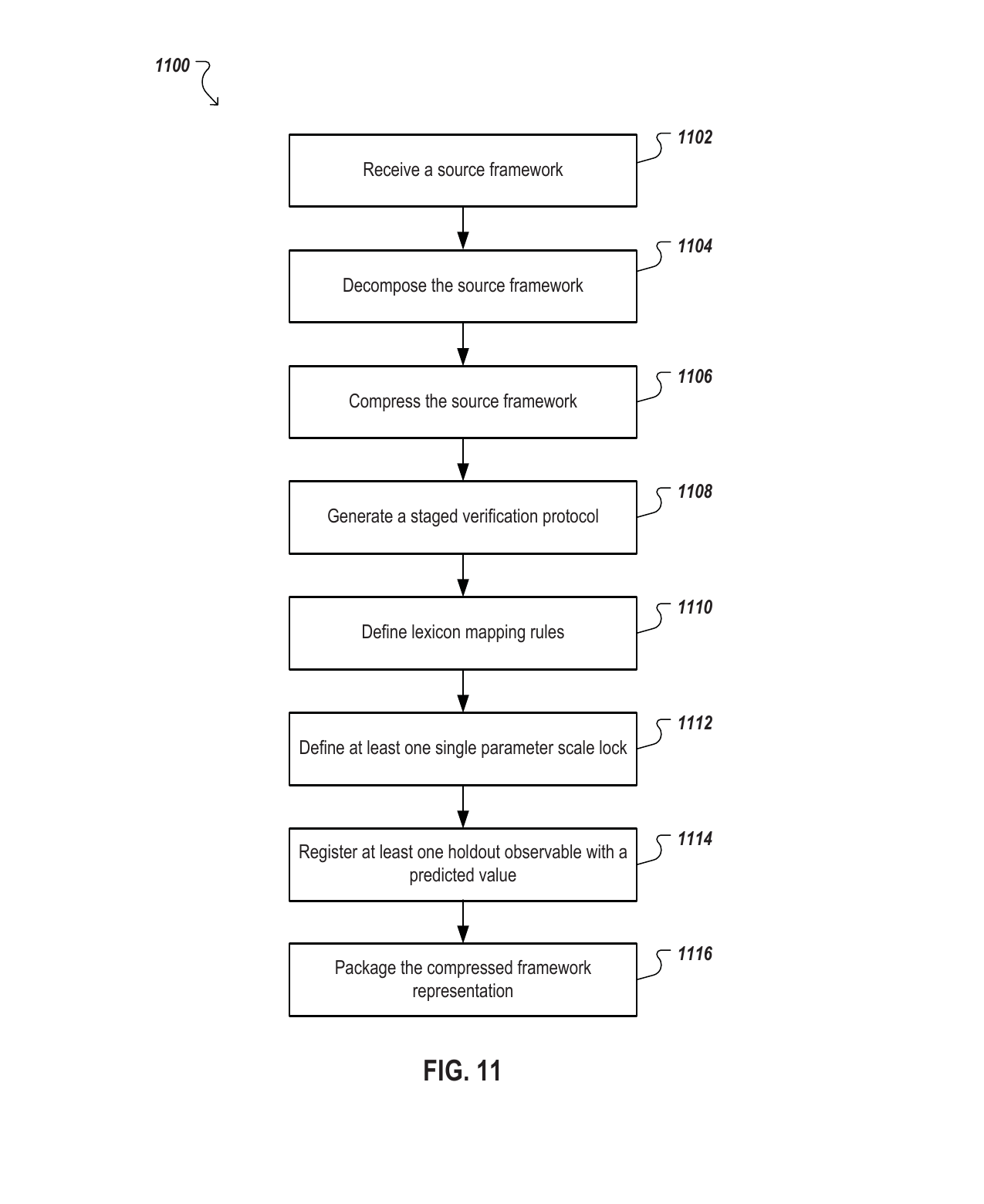
[0308]FIG. 11 is a flowchart illustrating an example process for converting a source framework into a packaged compressed framework representation. The process 1100 can be performed by a system that includes one or more computers, e.g., the system of FIGs. 1A and 1B or the system 800 of FIG. 8. The operations of the process 1100 can also be implemented as instructions stored on a computer readable medium, which can be non-transitory. Execution of the instructions, by one or more data processing apparatus, causes the one or more data processing apparatus to perform operations of the process 1100. For brevity, the process 1100 is described in terms of being performed by a system.
[0309]The process 1100 establishes an automated backend development and preparation channel that structures complex scientific knowledge into an optimized format for lossless storage, transmission, and rigorous verification. This processing sequence ensures that a target machine learning model can ingest complex cross-domain scientific rules without experiencing cognitive degradation, context memory saturation, or hallucinated parameter shifting during downstream reasoning loops.
[0310]The system receives a source framework (1102). This initial operational phase establishes a broad data acquisition gateway configured to ingest structured knowledge framework assets from an external storage module, a localized database repository, or a network interface API gateway, or other source. The system can read the incoming framework file, evaluate format boundary validations, and parse text strings, mathematical expressions, calibration variables, and contextual metadata into an unstructured content array held within local volatile memory buffers.
[0311]The source framework ingested during this operation can represent either a domain-agnostic technical schema or a highly customized, domain-specific architectural framework, such as a unified geometric physics framework that outlines interconnected geometric rules. For example, the geometric physic framework can span four distinct technical pillars: mechanics, electromagnetism, thermodynamics, and particle mechanics. This front-end ingestion layer supports data streams structured as serialized text files, JSON data documents, XML documents, and/or cloud-hosted database file streams. The system captures these raw inputs to initialize the active processing environment, providing foundational data tracking to support integrated session memory modules that persist framework discipline and verification parameters across a plurality of sequential user transactions.
[0312]The system decomposes the source framework (1104). This structural partitioning operation can be configured to execute algorithmic segregation on the uncompressed text array to structurally isolate global framework semantics into distinct, clean operational data blocks, thereby ensuring deterministic machine parsing by downstream components. The system can be configured to separate the ingested framework contents into multiple distinct, data arrays or records. These data arrays or records can include, for example, an array of primitive definitions that establish the foundational atomic data units for the target domain, an array of derivation chains that break down mathematical progressions and formulaic dependency graphs into discrete sequences with physical justifications, a registry of calibration anchors accompanied by original experimental measurement sources and empirical constants, and/or a registry of falsifiability anchors populated with pre-calculated theoretical predictions and expected range bounds.
[0313]During this decomposition loop, the system can extract atomic foundational units having no further decomposition within the underlying model and attach specific domain metadata tags to each isolated item to enable rapid categorization during subsequent semantic graph construction. Each outputted record receives a unique identifier and explicit relational cross-reference pointers to map absolute calculation provenance and structural dependencies across independent physical domains.
[0314]The system compresses the source framework (1106). This optimization operation can be configured to receive the uncompressed arrays of typed atomic units and execute multiple concurrent, or sequential, algorithmic compression routines to generate a compressed framework representation. This structural conversion reduces the physical file size of the technical knowledge base by approximately 40% or more compared to its raw representation while losslessly preserving complete semantic fidelity. This direct reduction in data footprint minimizes context memory utilization, eliminates token consumer saturation, and limits arithmetic drift caused by unnecessary domain switching or unit conversions during sequential neural reasoning steps.
[0315]The system can be configured to achieve this compression by selecting from a group of geometric compression primitives. The primitives can include, for example, one or more of: (i) topology integers that encode complex spatial and logical relationships as compact numerical arrays recording winding numbers, linking numbers, and torsion invariants to replace verbose geometric descriptions with discrete integer tuples, (ii) first prioritization or encoding that favors dimensionless ratios over absolute dimensional scales to protect the underlying database from measurement drift in individual absolute quantities, (iii) equation tagging that applies unique alphanumeric identifier tags to every individual equation and derivation step to eliminate text ambiguity and support fast database lookups, or (iv) elimination of redundant axioms to prune logically equivalent mathematical expressions from the active framework file, purging full text blocks and inserting compact chain pointer references to canonical formula forms to maximize context window efficiency. Any one or any combination of these can be used for compression.
[0316]The system generates a staged verification protocol (1108). This protocol creation operation can be configured to transform raw atomic units into structured validation rules, producing an independent, machine-readable validation configuration that functions as an unalterable programmatic barrier to audit the data ingestion fidelity of a target AI model before enabling downstream reasoning operations. The system can populate each validation substage record within the protocol configuration with an explicit stage identifier, detailed execution instructions, strict pass criteria thresholds, and automated fail action recovery codes.
[0317]The protocol maps out a multi-pass initialization validation gating sequence designed to systemically prevent an AI model from operating on partial, corrupted, or misaligned data strings. In some implementations, the generated staged verification protocol explicitly structures a sequence of four distinct validation gates. The validation gates can include a load-and-integrity check substage that evaluates baseline file completeness and schema alignment by running localized hashing loops over the serialized arrays to match live computed runtime checksum values against embedded cryptographic validation hashes. The validation gates can include a quote-back confirmation substage that transmits programmatic instruction strings to the AI model requiring a character-for-character exact text reproduction of specified framework portions (such as reproducing verbatim at least the first N lines and last N lines of the framework package, e.g., where N is at least 5) within a localized evaluation buffer. Here, any single character or token deviation causes the entire load verification to fail. The validation gates can include a lexical enumeration and self-consistency check substage that directs the model to systematically extract primitive records from the internal semantic graph, enumerate registered primitives with exact definitions, trace calibration chains to anchors, and verify cross-domain dimensional consistency and loop quantization conditions. The validation gates can include an analytical stress test substage that invokes the falsifiability anchors registry to direct the AI model to apply the dependency graph of validated equations to independently compute target numerical predictions for pre-registered holdout observables across a plurality of distinct pillars or domains of the framework.
[0318]The system defines lexicon mapping rules (1110). This terminology stabilization operation can be configured to map out real-time translation configurations and formats them into an independent, machine-readable array containing typed dictionary records to maintain absolute semantic consistency across distinct execution regimes. Each embedded record links a canonical framework primitive term field with a conventional legacy science terminology alias, populating the database translation table with authoritative definition strings and bidirectional translation boolean flags. In a physical geometric framework layout, this operation creates explicit associative pairs that bind legacy physics expressions directly to their underlying geometric loop primitives, such as pairing the legacy term “particle” with a canonical “stable closed harmonic loop” primitive, pairing the legacy term “force” with a “gradient of missing-space profile” primitive, pairing the legacy term “charge” with an “orientation-gated effect of a rotating loop” primitive, pairing the legacy term “field” with a “smoothed cost map of many routes” primitive, and/or pairing the legacy term “mass” with an “integrated display-area action of a closed loop” primitive.
[0319]These embedded rules define the authoritative lookup matrix utilized during active model reasoning by a live lexicon mapping subsystem and drift detection subsystem to execute lexicon locking. The system leverages these rules to maintain a usage frequency table that tracks primitive utilization across output token streams, executing automated trend analysis across a sliding token history to catch and suppress slow, creeping vocabulary divergence patterns before cumulative semantic drift can corrupt multi-step derivations.
[0320]The system defines at least one single parameter scale lock (1112). This immutability definition operation isolates fundamental constants and foundational parameters within the calibration anchors array and hardcodes them to fixed numerical values with associated physical unit strings, marking the parameter record with an unalterable immutable boolean flag . For example, in a unified geometric physics deployment, the system hardcodes the primary action scale parameter to an exact unalterable value where S ℏ 1.054571817 10 𝐽 ∙ 𝑠.
[0321]This operation locks foundational scaling variables before any token execution commences, ensuring that the primary parameters cannot be dynamically re-tuned, adjusted, modified, or floated in any reasoning context to forcefully mask mathematical errors or cover up intermediate cross-domain discrepancies. By hardwiring these numerical boundary restrictions directly into the calibration data block layout, the system enables a real-time scale enforcement module or a hardware-level scale lock comparator loop to intercept all mathematical operations, numeric evaluations, and parameter assignments performed by the model within its active processing loop. When an unauthorized mutation attempt is detected, the system proactively intervenes to reject the operation, suppress unauthorized token generations, force the retention of the original locked value, and inject automated system explanations into the active execution pipeline.
[0322]The system registers at least one holdout observable with a predicted value (1114). This validation target registration operation can be configured to process data within the falsifiability arrays to connect pre-calculated theoretical outcomes with empirical testing criteria, grounding abstract reasoning in experimental reality. The system populates a structured holdout registry configuration with specific data fields, including, for example, a unique observable identifier, a predicted numerical value with physical units, a multi-dimensional uncertainty tolerance band, peer-reviewed empirical references, and/or a dynamic comparison status field initialized to a placeholder pending state.
[0323]In a physical systems application, this operation catalogs target predictions for multiple physical properties, including the hydrogen Balmer alpha wavelength and the muon mass. The system pairs each registered holdout observable record with a direct cross-reference pointer pointing back to the specific unique equation identifier (such as tags ranging from F0001 through F0031) that generated the initial prediction, mapping explicit calculation provenance. This registry configuration protects the downstream reasoning environment from uncalibrated extrapolations by enabling the verification subsystem during initialization, or an error propagation subsystem during live execution, to run a precision range-verification loop. Generated analytical predictions are evaluated against the explicit uncertainty tolerance bands to ensure strict compliance with a theoretical baseline error band or closure tolerance threshold designated as Jc = ±0.01% before transitioning the system out of its protective lockout configurations.
[0324]The system packages the compressed framework representation (1180). This final serialization and compilation operation acts as the terminal aggregation node of the preparation channel, accepting the independent outputs generated by the compression, verification protocol, terminology mapping, scale locking, and holdout registration components to hierarchically structure them into a single machine-readable package document that complies with a rigid validation schema. The system can structure the losslessly compressed geometric primitives and formula lists into distinct schema arrays (including PRIMITIVES and DERIVATION_CHAINS), nest the validation instructions into a VERIFICATION_PROTOCOL metadata block, populate the LEXICON_MAP table, injects the unalterable parameter configurations into a SCALE_LOCKS registry, and places the empirical test targets inside a FALSIFIABILITY_ANCHORS block.
[0325]The system compiles this document into a structured file format, such as a JSON or XML data file, which maps explicit field keys, typed values, and array bounds to support automated parsing loops by downstream hardware-software hybrid initialization components. To secure the finalized framework package for safe transmission and federated delivery across distributed systems without risking file-level corruption or unauthorized schema modifications, the system can append a global header block containing structural metadata and processes the entire byte stream to compute and inject a cryptographic signature or checksum value directly into the validation block.
[0326]This packaged document functions as a completely self-sufficient unit of delivery that carries its own parameter protections, carrying all necessary technical metrics to alter the mathematical boundaries within which token execution occurs and optimize context window utilization. When provided as an input payload to an AI model, the package structures active session memory modules to persist the verification state and the loaded framework across a plurality of sequential computation cycles. The resulting package explicitly coordinates an automated ordering controller functioning as a strict state machine, forcing the runtime environment to cycle through a series of explicitly logged operational states. These states can include, for example, a load pending protective lockout state that suppresses active user transactions while the multi-pass verification protocol is evaluated, a verified state that unlocks standard runtime query monitoring under concurrent background execution filters, an enhanced transparent math-audit mode active state that sets an internal flag forcing the model to apply a structured template demanding the explicit exposure of alphanumeric equation identifiers, dependency chains, variables with source tags, dimensional analysis, and tolerance propagation metrics for forensic tracking, and/or an unverified error state or human review state that triggers an immediate hardware interrupt to isolate the active tracking infrastructure and permanently halt reasoning operations upon intercepting a critical alert exception.
[0327]Furthermore, this packaged structure provides structural support for an alternative execution layout featuring a dedicated physical hardware co-processor communicating with a host computing architecture across a high-speed data interconnect layer. Within this hardware-software hybrid governance configuration, high-throughput verification pipelines, error propagation tracking units executing tailormade arithmetic logic gates, and drift detection block trend analyzers are offloaded to physical circuitry on the card. This circuitry utilizes hardware-accelerated content-addressable memory configurations to operate as read-only lexicon lookup units alongside dedicated arrays of physical comparison registers, executing parallel boundary checking and regime enforcement filters at its native clock speed independently of primary host processing cycles.